What unites Gordon Brown, George Osborne and the talk show/podcast host Conan O’Brien? A devotion to the works of Robert A Caro, that’s what. I’ve long been intrigued by Caro’s phenomenal reputation. Biographies are published all the time: Ben Pimlott wrote a really famous one about Harold Wilson. But (pace Nick Thomas-Symonds) there’s only one leader from the 1960s that British politicos want to read about on their summer holidays. Caro’s multi-volume take on the life of Lyndon B Johnson is, for a certain part of the Westminster village, a beachside must. I wanted to know what the fuss was about, and was presented with Working: a canter through Caro’s professional career to date. (The ‘to date’ is important: Caro is now 87, and his published works on LBJ have brought the reader only to 1964. His fifth volume is much awaited.) Working is a series of pieces covering Caro’s early career, his biography of Robert Moses, the LBJ books and then some detailed reminiscences from the trail. It’s a fairly quick read but it will make you consider what a biography – and a biographer – should do.
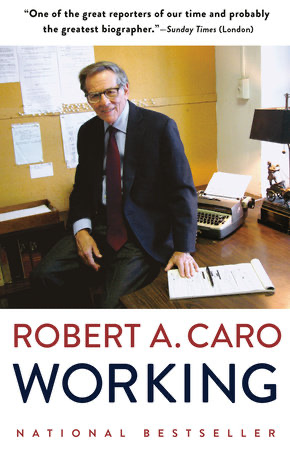
Half way through Working, I know I want to read Caro’s 1,300 page biography of Moses, a bureaucrat I’d never previously heard of. Just how was it that a man unelected to public office could remain for decades the most powerful force in the regeneration of New York? How did Moses gain this power, how did he deploy it and to what ends? Those are the questions that Caro sets out to answer. Both Moses – and Johnson – might be less interesting as men than the power that they were able to wield. But Caro never forgets that the character is central, so he never stops trying to understand his subject.
And there are two elements that make Caro’s approach unusual. Because he wants to explain the effect his subjects had on others, he is able to widen the lens. He tells the story not only of Robert Moses and the other powerful players but also of the powerless. There were men for whom Moses would redesign the route of his expressways. There were others whose lives would be ruined because Moses would refuse to move a parkway by less than a tenth of a mile. There were communities destroyed because Moses didn’t consider the lives of those within them as warranting his care and attention, and local democracy provided no space in which their voice could be heard. There are so few biographies that explore – really explore – the lives touched by their main subject.
The other issue – which may raise questions if Caro’s books on LBJ are never completed – is that Caro almost doesn’t know when to stop. He interviews and re-interviews contacts in the hope that he will get closer to the truth. He cites examples where contacts change their story as they get to know Caro – or his wife Ina – better. To learn about LBJ’s childhood he lives in Texas Hill Country, even going so far as to camp out on his own to better understand the loneliness and solitude felt by Johnson and his brother. He gets the runaround from Johnson’s college cohort, and it’s only through a mixture of hard work and dumb luck (the kind of dumb luck that arises through hard work) that he finds a source that many assume to be dead. He gets up at 5.30am to replicate LBJ’s commute to work. Caro explains that he was taught to keep no page unturned and he has taken the spirit of that instruction to heart.
The results of Caro’s approach are vivid. And that spills over to Working, which could have been a dry collection of hints and tips but which instead opens the window to a writer who is tenacious, demanding (of himself but also of Ina who deserves a great deal more credit) and occasionally irascible, and to a craft which involves patience, imagination and a determination to think of history not just in terms of great men but also of the people and the causes that are so often cast aside. But it’s reasonable to ask whether Britain’s politicians, lobbyists and political advisers, who have studied Caro in their droves, have done anything like enough to give power to those without it. If you read Caro and think that the idea is to do a Robert Moses but more efficiently, you’ve really not been paying attention.
 Cafethinking