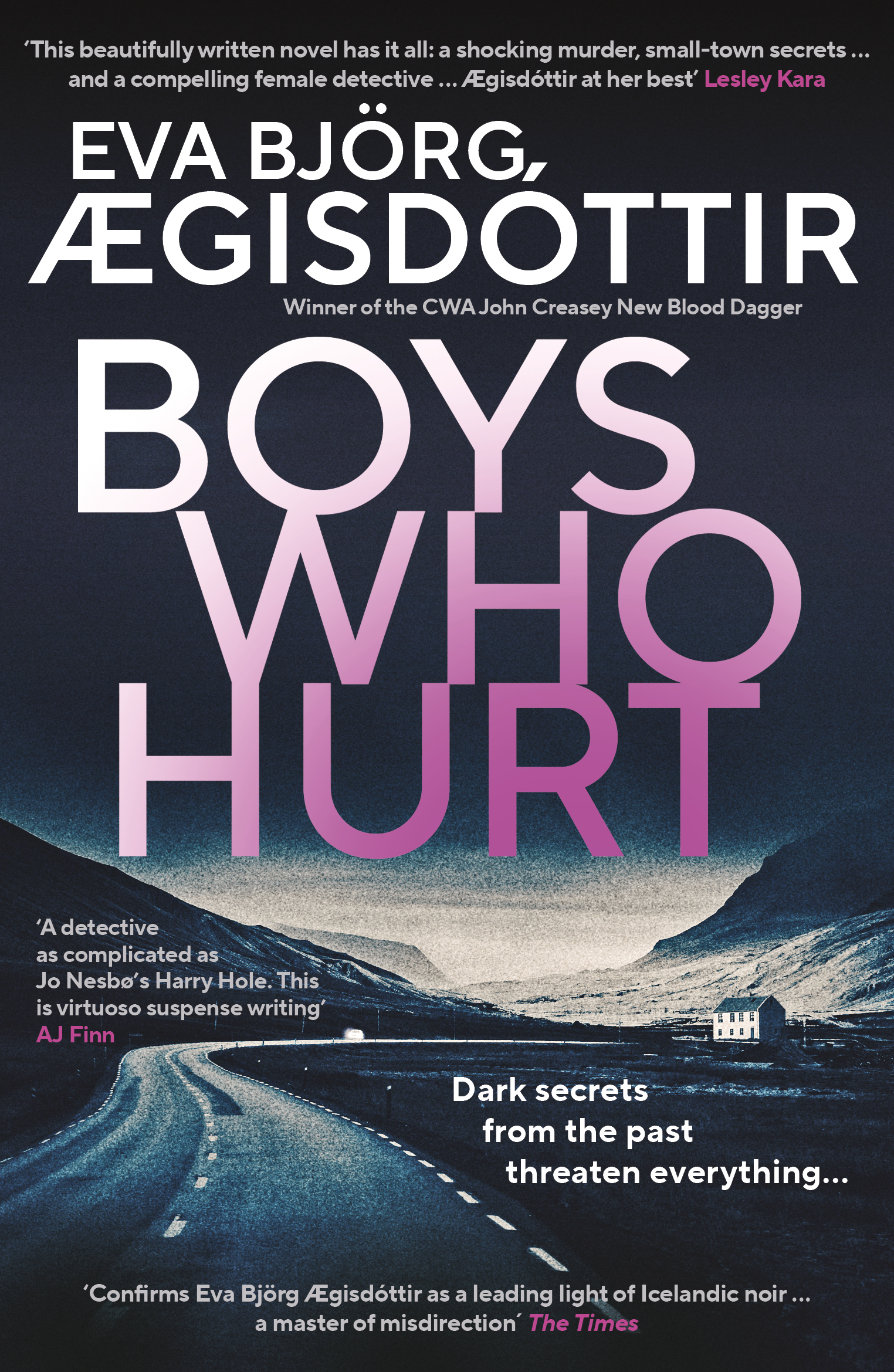
In the second half of today’s Forbidden Iceland double-bill, we’re back up to date. Except that we never really are. Boys Who Hurt has us bouncing around unpeeling buried trauma that dates back decades. Eva Björg Ægisdóttir has us furious at the powerful and the upstanding in society. Elma and co are on the case, but as we’ve seen before from this author, we are judged just as much as those who meted out such brutal and casual cruelty to children a convenient number of years ago.
I am not sure how we would finally calculate the body count, but Thorgeir is the first to go. He’s one of society’s misfits, so when he finally falls in love at the age of 41 we assume that not all about the relationship is what it seemed. There’s something about his mother (who conveniently happens to be the neighbour of Elma and Sævar) that’s not quite right either. Both Thorgier and his father happen to have died out at the family summerhouse. But in another coincidence Sævar manages to make a link to an incident 25 years earlier, which was officially an accident but which was clearly never investigated properly. The culpability for that accident has never been properly settled, and official justice may never now be done because (a) powerful people don’t wish it (b) the people who were there are now being systematically murdered.
We’ve seen before that this author lives in ambiguity and with this novel that goes right to the title. Boys Who Hurt, we think, are bullies. But as more and more is revealed, it’s clear that it works two ways. These boys have been hurt, by each other but also by toxic family relationships. At least two families seem to think nothing of handing out beatings to the children – in one case it’s explained (though not excused) by drink but with the other family it makes even less sense. Was the perpetrator of ‘the incident’ acting deliberately? It’s possible to argue either way. Ægisdóttir puts us on the spot with that question.
Meanwhile, just to keep us on our toes, there are baby girls aplenty (OK, there are two) in our detectives’ families. The domestic bliss of now contrasts with the horrors of only 25 years ago but the fact that this brutality is only a generation away challenges us to ask whether we can really spot this kind of thing, and confront it.
Angry and righteous, Ægisdóttir wants to know whether we will really support the most vulnerable. This, of course, is a recurring theme in the outstanding Forbidden Iceland series. And yet, she (with Victoria Cribb’s translation) manages to keep everything so deceptively light. She gives us clues. She keeps us across the detectives’ latest thinking (and they ask all the questions we would have failed to think of). And then, with 50 pages to go she gives us a big hint that even this reader can’t fail to pick up on and we know we’re in for a helluva finish.
I’m writing this review during the UK general election and there’s an old saying: campaign in poetry, govern in prose. But given that Ægisdóttir’s message is frankly bleak, there’s a real trick in the way she (and, again, Cribb) deploys her prose. The writing is so fine, the plot is so straightforward, that you’re admitting your complicity in society’s rottenness and pledging support to something better while hardly being aware of it. It’s time to choose, but Ægisdóttir has made that choice for you already.
Thanks to Orenda Books for the review copy and to Anne Cater for the blog tour invitation.

 Cafethinking