Nobody Walks is a ‘bonus’ (ie not one of the main eight) novel set in the Slough House/Slow Horses universe. It’s well worth a read, and if you can do it in the right order then all the better.
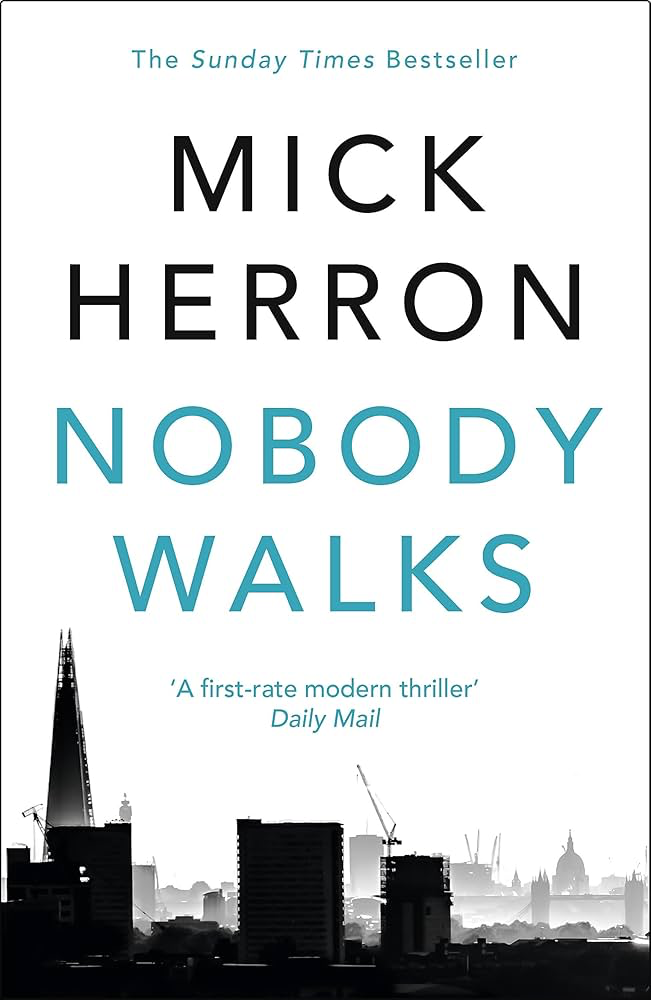
It comes after Dead Lions (novel/series 2) and The List (a novella), and before Real Tigers (novel/series 3). What’s great about these bonus books is that they give Mick Herron a chance to step outside the normal format and to tell stories in a different way, which gives us readers a fresh insight into spyland. Nobody Walks is also notable as it’s the first time we meet Ingrid Tearney, a real watch-between-your-fingers baddie whose deployment of state security for personal gain is far and above anything we’ve seen before from Diana Taverner.
Tom Bettany is a retired agent: his life as a joe was tough for his family and now he lives a ghost-like life working in a Marseille abattoir. He returns to Britain when his son dies, and something seems off. His investigation will see him deliberately gain the attention of criminal kingpins who’ll want revenge for the role he played in placing them behind bars. In the process, Bettany realises that he’s operating as two characters that blur unconvincingly into one: the Bettany who is an avenging and grieving father, and also Martin Boyd, his identity when undercover. He has enemies who are after Bettany, and enemies who are after Boyd, and the worst bit is that he can’t play them off against each other.
But if a retired joe can’t live in a state of certainty, neither can a neophyte. Nobody Walks compares the various instincts and understandings of Bettany with those of the psychologist J K Coe, whom we met for the first time in The List. Coe is deployed by Tierney as her main contact with Bettany. We won’t spoil how that turns out, but watching Coe struggle his way to understanding what is being required of him, and the way in which both Tierney and Bettany take advantage of his lack of expertise is compelling to read.
All this enables Herron to present a kind of syllabus for spy school. Your first level in bluffing is to make people think you know your way around the Park. Then, when being trailed, you do a basic move – ‘an amateur move, designed to make another amateur happy he’d not fallen for it.’ You spend a lot of time not falling for things, and there’s an expected level of expertise. Dancer, who sells guns and information, reminds Bettany that he’s selling the news of Boyd’s resurfacing in London as soon as he’s out of Dancer’s shop: ‘Can’t work that out, I’m not surprised you’ve had to go freelance.’ Meanwhile, there’s a whole load of muscle who bring brawn to the party and who are easily outsmarted, by anyone.
The ending’s dark, but its ambiguity is spot on. When you live your professional life in the shadows, does it matter what causes the darkness? Especially, that is, when darkness can fall from all directions. Bettany knows enough not to care. Coe, on the other hand, cares very deeply indeed. What he learns from all this will be interesting to observe in future novels.
Our other Slow Horses/Slough House coverage:
 Cafethinking
[…] All he has left is fighting moves, and these are the spook skills that Coe respects the least, having been on the receiving end of them. Later, River misses cues and clues when his grandfather, the OB, calls him, because he’s too […]
[…] Nobody Walks […]
[…] Nobody Walks […]
[…] Nobody Walks […]
[…] Nobody Walks […]
[…] Nobody Walks […]
[…] Nobody Walks […]