If you want some perspective on the 2024 USA presidential election, you need to step away from the hot takes and their fury or delight. Almost all of them take some aspects of the result and plug them into the writer’s existing world view. (That’s true, of course, of almost all commentary, including on this site. But I digress.) In order to get some perspective we’ll need to open up a little bit. Nick Bryant’s book When America stopped being great, first published in 2021, attempts to do that. I started reading it a while before the election, but have returned to it this week. It might be a while before I’m able to draw useful conclusions about this election, but Bryant’s analysis of the last 40-60 years is a good guide to what has brought us to this point.
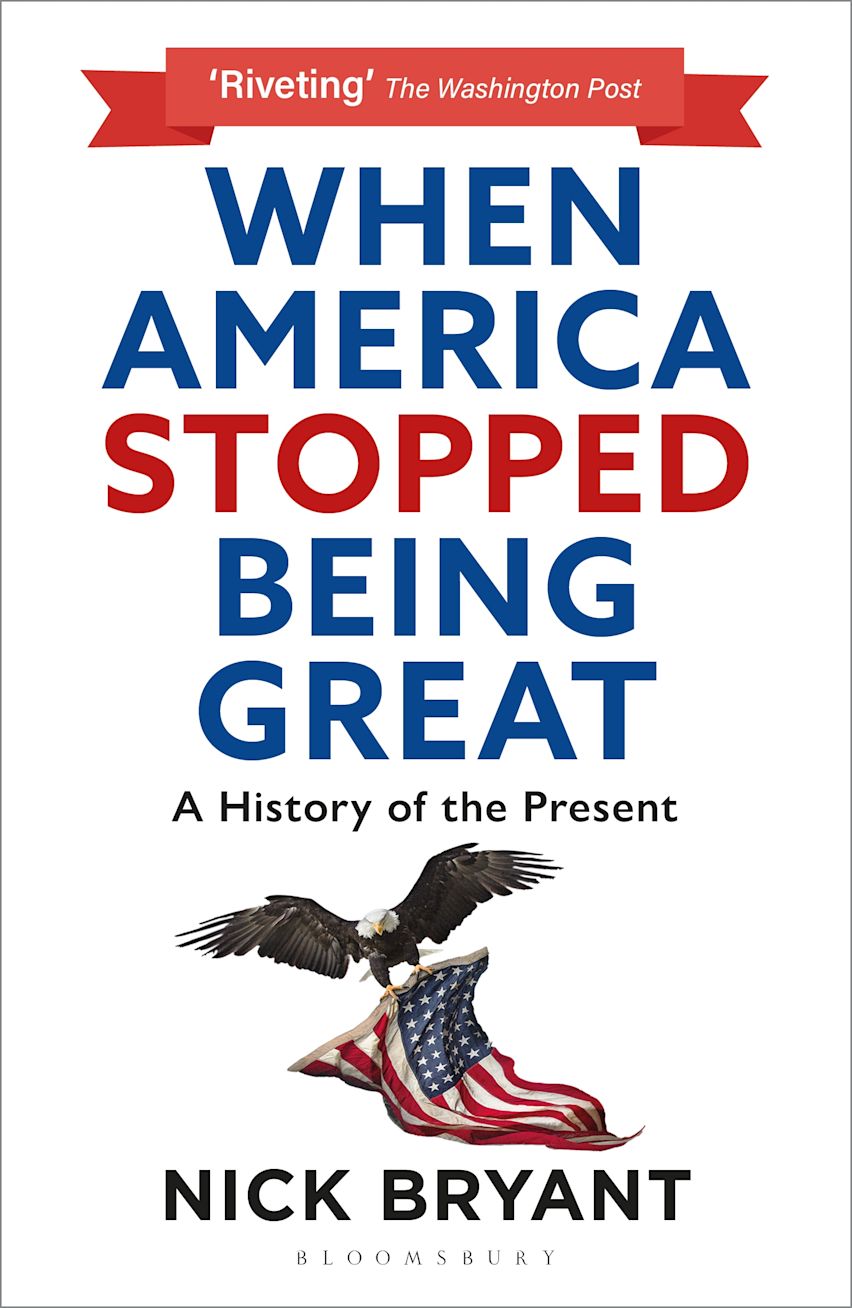
Bryant is a Brit, who fell in love with the States as a teenager as a result of imbibing its popular and political culture. He’s spent serious time in the stacks of the JFK presidential library in Boston, he’s been a BBC reporter on the Washington beat, and he moved his family to Brooklyn. He loves the place and has studied it closely, but with the eye of an outsider. This gives him some objectivity but disappointment, anger, love and hope shine through the pages.
Bryant’s thesis is that America has stopped being great because the institutions that enable it to be great no longer work. It used to be possible to get things done in Washington – the ability to work across the aisle was a valued attribute – but now any sign of bipartisanism will get you deselected back home, especially if you’re a Republican. It used to be possible to keep elected officials to account, but now no one can agree what constitutes the truth. It used to be possible to uphold standards but now impeachment investigations see divisions on party lines.
Everyone involves gets a good kicking but Bryant reserves special scorn for Ronald Reagan who was great at playing the public part of president but who fell ‘pitifully short’ when it came to the actual job: ‘intellectually incurious, often comically ill-informed and overly reliant on the cue cards he read from in meetings, without which he was often reduced to incoherence or silence’. Each new president reacts to what has gone before: George W Bush gets over-involved in Iraq and Afghanistan, so Barack Obama fails to act in Syria. Nobody sets out a real vision for what America should be doing in a world where the Soviet Union no longer exists but China and Russia have very clear strategies for their own advancement. (Even if such a vision existed, the American state is too hollowed out to act on it.)
Perhaps the reason that no one has moved on from the Cold War is that the Reagan myth still overshadows his successors – and the myth that Reagan defeated the Soviets (the Soviet Union was quite capable of falling apart on its own) continues to loom heavily. But this relates as much to economic as to foreign policy. Neither Clinton nor Obama particularly challenged the economic model that has lead to a massive rise in income inequality. Indeed, the role of Clinton’s repeal of Glass-Steagall and the Commodity Futures Modernisation Act in the 2007-8 financial crisis is well understood. But even when Keynesian solutions were provided – see also Bidenomics – the case for an active and interventionist state has not been successfully made. And even if there were the political will for a new era of big government, the ability of government to produce the reversal in policy failure that has dogged the last 40 years is unclear.
Writing in 2021, Bryant has much to say on the hollowing of the Democratic Party under Barack Obama. He is convincing on Obama’s failure to invoke the heart as well as the head. But I would be interested in reading deeper analysis on whether the failure of the Democrats (and the success of the Republicans) is as much to do with the incentives in play for different actors (individual candidates, media owners, tech bros etc) as Obama’s blend of cerebral detachedness.
For much of the book, I’m wondering what definition of greatness Bryant would suggest: there’s not a great deal of greatness in sight. A passionate final chapter sees me right, and what I especially like about Bryant’s view is that it, by and large, eschews a certain type of exceptionalism. America, he says, has let its people down for far too long now. Putting it right in 2028 is not going to be easy, but this book is a good place for a British observer to start to think about what might need to be involved.
Thanks to Bloomsbury Publishing for the review copy.
 Cafethinking