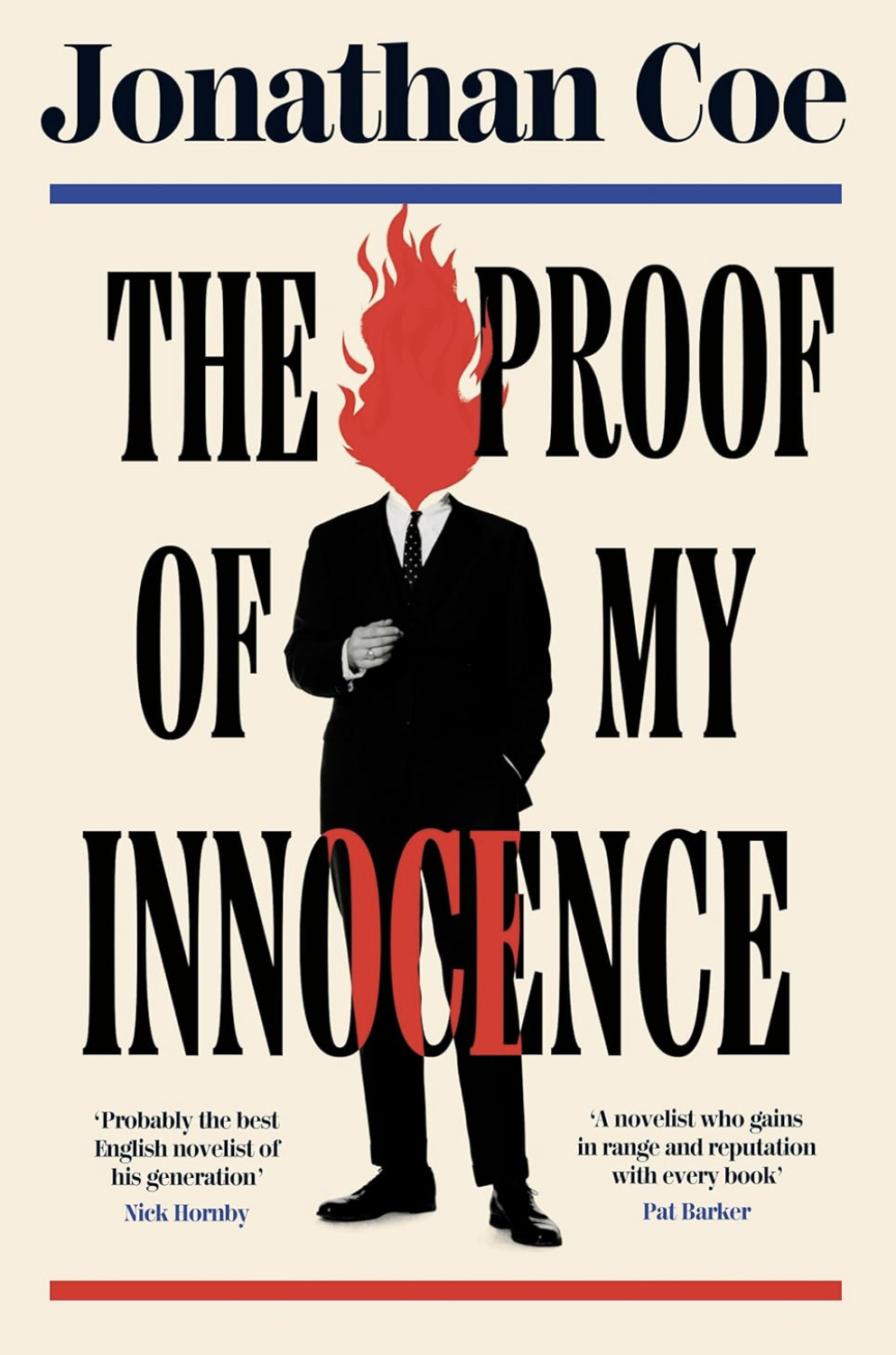
What will we think of Jonathan Coe’s novel, The Proof of My Innocence, in 30 years’ time? And does it matter? As with Anthony Horowitz’s Alan Conway/Atticus Pünd/Susan Ryeland series, we’re offered a novel that seeks to subvert its own form, but while Horowitz gives us smooth entertainment, Coe comes up with something altogether more freewheeling which is somehow both lighter and heavier. Lighter – because he breaks so many rules that you’re not always sure how to approach the material. Heavier – because Coe is busy asking questions of the reader and doesn’t hang around waiting for our answers.
Supposedly, this is all about Liz Truss. The novel opens with her poised to become prime minister; its last pages quote from her resignation speech. Coe is furious that her brand of Conservatism (which we’ll a little sloppily label as ‘popcon’) could have propelled her to power and he’s keen to emphasise what he considers that particular ideology’s illegitimacy: it can win office only by being dishonest about its intentions and its victory, however short-lived, shows the rottenness of a society that pits old against young, puts a stop to the limited social mobility that was possible during the post-war consensus and which, moreover, can no longer agree on what constitutes a fact.
Some of these themes have been previously explored by Coe and others. What’s different here is that Coe shifts through three literary genres: cosy crime, dark academia and autofiction. The requirements of each genre mean that although the over-arching plot does make perfect sense, there are inconsistencies that can trip up the reader. These inconsistencies don’t restrict themselves to facts: we spend quite some time trying to work out whether Coe is sympathetic to each of these genres and what that sympathy might mean.
Take cosy crime, for example. Coe takes the notion of the eccentric detective and really runs with it; he criticises familiar elements such as secret passageways. The supposed writer is doing cosy crime because she thinks it will be easy. So where there are elements that don’t necessarily land, we can’t necessarily tell whether Coe’s doing it on purpose.
He’s on firmer ground when we get to dark academia, and maybe this is where his loyalty lies, as he’s covered 1980s excess before. A theme of dark academia is that higher education was so much better when people (students, lecturers) could wander around reading novels all day: a character who has supposedly come to Cambridge to study medicine but spends his time in the philosophy, history or English literature lecture halls is one of the heroes of the novel. Social circles at 1980s Cambridge were determined on class lines, but this means that although we can seethe at the exclusion of the novel’s main protagonists from the ranks of those who will, forty years later, be the thinkers behind Truss, we don’t really get to see the popconners up close.
And the reaction of the normal folk is to find their niche, away from the corridors of power. They might become a vicar and undertake minor good works, or set up an ethical business. What they don’t do is find ways to seriously oppose those with power. Even the great scoop that someone thinks they’ve got, had it been published, would have done very little to change the political narrative. Truss was brought down by the markets, not by her associations with Tufton Street which were widely known about even if they were not always transparently reported.
I wonder whether Coe believes that he should himself have done more. He appears here, lightly disguised, as a Cambridge student and a contemporary of the popconners. And when he isn’t encouraging us to think about the potency of literary fashion, and having his characters be appalled by the success of Martin Amis (in particular, by Money) he’s asking: what should, what could a novelist do about it all? Is it right to pander to fashion, or should a writer aim for legacy? And where does truth fit in with all this, anyhow?
Those are big questions, and at times things can get a bit overwhelming. Coe is a master of the set piece, and feeds us a few; at times we’re wondering whether we’re missing too many of the references. Is this a reference to Women in Love? Is that a reference to Don’t Look Now? (Yes, it was.) You don’t have to notice them all, in fact you don’t need to notice any of them. But to get the most out of this novel you need to be prepared to let Coe take you in numerous directions. There’s some cosy crime and some laughs at Liz Truss’s expense, sure, but – unlike your standard mystery writer – Coe wants you to do some work. The state of the nation depends on it.
Thanks to Viking for the review copy.
Other Jonathan Coe on Cafethinking:
 Cafethinking