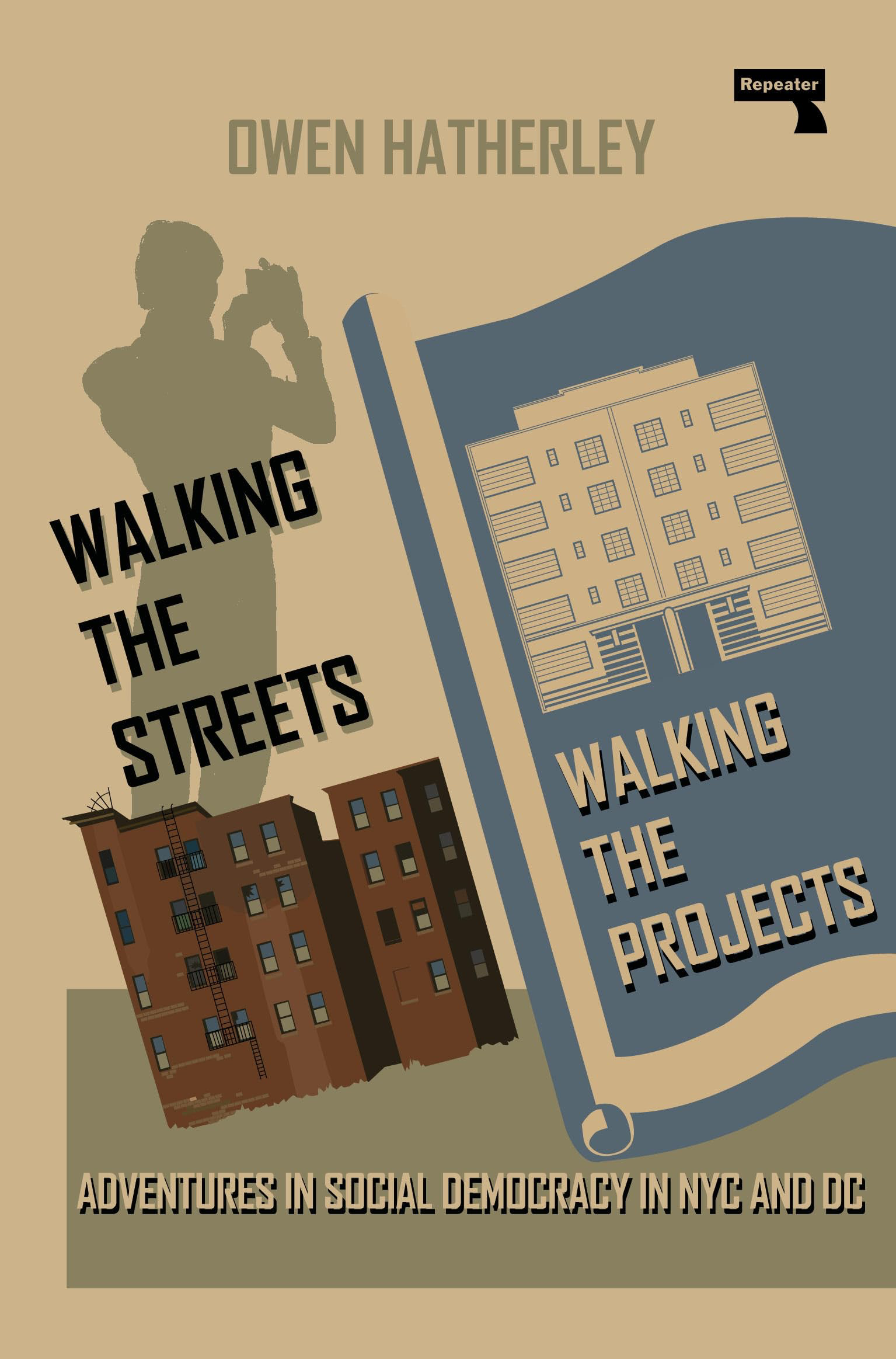
I wanted to read Walking the Streets/Walking the Projects: Adventures in social democracy in NYC and DC because the premise sounded fun: who doesn’t want a social democracy adventure? Plus, The Power Broker was sitting on my bookshelf and I wanted to know what Owen Hatherley had to say about it. Three pages in, he tells us he hasn’t read The Power Broker, so I thought I should read that first, and started it (though I still haven’t finished it). I picked up Streets/Projects again on a flight into NYC. In some ways it made for far better last-minute trip preparation than did my much-thumbed standard guidebook.
You may know about architecture, and cities, and Hatherley’s views on all these. This was my starting off point, and within a paragraph of the introduction, I’m lost. There are signifiers and references which I don’t understand. Hatherley talks about a whole bunch of folks and I’ve heard of perhaps two of them. It’s not as though I was expecting a Ladybird guide, but I’m hoping that Hatherley will at some point defend his polemic. I cling on to an early sentence which makes me think I might get my head round it all eventually:
Yes, you can understand the city from using your eyes and your ears, no you don’t need any special knowledge and least of all a sinecured position to do so.
By the time Hatherley’s got his views on JFK airport off his chest, he’s better company. He talks about architectural fashions in the 1900s and on the curiously old-fashioned styles in which New York built its technologically-advanced skyscapers, sandwiching a section on the Lincoln Centre. He prefers London’s Royal Festival Hall, and explains why. Now we’re getting somewhere. He discusses the development of the centre, and where power lay, and how an entire neighbourhood of the powerless (who just happened to have black or brown skin) was razed to the ground to provide the space. Then Hatherley goes to Times Square, and discusses different usages of urban space and the balance between sleaze and money that has fuelled its story. And then there are references that this ill-travelled reader gets, and we’re off to the races. Times Square, you see, looks like a ‘mere Piccadilly Circus’ with ‘nothing so gloriously seedy as the grimy light boxes and anime characters of an Akihabara or Shinjuku’. Hatherley continues around Manhattan, pointing out weird buildings, discussing the ‘prosperous and wonderful’ Rockefeller Center and making arch comments about the MetLife building above Grand Central Station. We learn about the ‘“skyscraper index”, which predicts that the completion of a “world’s tallest building” will either immediately precede or coincide with a financial crash’. And he explains how these buildings fit with the social history of the city.
But we’re here for social democracy and adventures therein. Hatherley goes to Roosevelt Island, to Queensbridge, to Washington where the metro is brilliant (and is a strategic attempt to provide a universal service in a land that prioritises ghettoed services) and then back to New York where it is squalid, but also brilliant. He explains the tension between social housing and the market; between communities and developers; the legal restrictions that are meant to lower – yes, lower – the quality of social housing. Every few blocks, as we walk around New York, I find myself saying, ‘According to Hatherley…’ Eventually I mix it up with, ‘Owen says,’ in an attempt to avoid annoying my wife. In this, I fail.
But Hatherley is an excellent companion, and bookends our trip – our return journey involves some time in the fabulous TWA Hotel at JFK which also ends his book. He’s witty and knowledgable. I did look in vain for his book in NYC bookstores (all of which, of course, stocked The Power Broker), for I would like to think that New Yorkers would have their views on his commentary.
I don’t really intend to reduce this polemic to the status of an upmarket guidebook. Partly, that’s a function of how I experienced it. But it’s also due to the book leaning heavily on Hatherley’s views and his sources that are primarily formal and written, rather than verbal. There are few interviews, few other voices to mix things up, despite the premise that the city is seen best when walking in it rather than observing from a map. Among the canon of city planning discourse, I’m not sure where to put it. But if you’re going to New York, and have perhaps heard of Piccadilly Circus and Akihabara, don’t leave home without it.
Thanks to Repeater Books for the review copy.
 Cafethinking