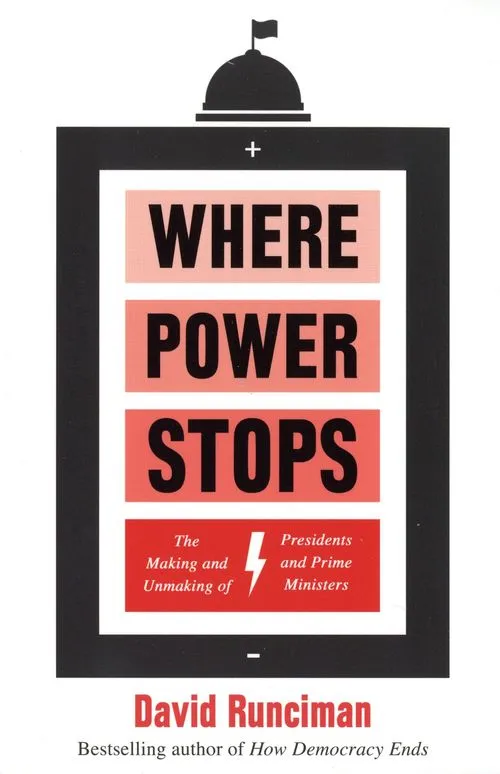
David Runciman offers us a book about power, but he gives us one about political biography. Where Power Stops: The Making and Unmaking of Presidents and Prime Ministers is a collection of edited essays that originally appeared in the London Review of Books, with an introduction and an afterword that seek to tie the essays together. If you already know a bit about Lyndon Johnson, Barack Obama, Gordon Brown and Margaret Thatcher, you’ll be able to follow it all. It’s witty and engaging and it may well make you reconsider expected truths. But as a collection it is less than the sum of its parts.
Right at the start Runciman says he is going to disagree with Robert Caro’s view that it is the deployment of power that reveals the character of the leader. He will go on to make an interesting argument that LBJ ‘did’ civil rights not because it was right but because the political imperatives facing him were to honour Kennedy’s memory while proving he was his own man. But why is he focusing so quickly on Caro, rather than, for example, setting out a new analysis of power and explaining why his chosen subjects fit that analysis? That would help us to understand the omission of Wilson and Nixon and the inclusion of others. The answer, of course, is that the subjects of these chapters wrote autobiographies or had biographies written about them, and Runciman was commissioned to write essay-reviews about those works.
Runciman’s problem (which becomes our problem) is that the source material is of such variable quality. At one end you have one of Caro’s four volumes on LBJ. At the other you have Tom Bower’s hatchet job on Blair. And in the middle you have Gordon Brown’s autobiography. Caro famously interviews and re-interviews until he thinks he really knows what’s happened. Bower is busy trying to paint a picture. And in the case of Brown, we’re never sure whether he actually believes what he’s telling us. But Runciman has to interact with his sources. So he (rightly) giggles at an anecdote about Elton John, looks agog as Brown asserts that if he’d only mastered Twitter he’d have saved his premiership, and points out that the kiss-and-tell written about presidential candidate John Edwards could be written only once the writer has concluded they’ve got nothing to lose from spilling secrets.
‘Power doesn’t tell us the true nature of the man; the man tells us the true nature of the power.’ But, later: ‘What matters is not who people really are. What matters is what they end up doing with the power they have, large or small.’ The problem here has to be the nature of the political biography as an historical source, or, more accurately, the political biographer. Even a storied reporter such as Bob Woodward is reliant on their sources, and Runciman points out that those source have their own reputation to protect.
Each of these essays works very well as a stand-alone review. In fact, after reading the LBJ chapter I pull out my copy of The Passage of Power. Folded into the back cover are three press cuttings carefully placed by the book’s previous owner: here’s the TLS, there’s the NYRB and lo and behold here is Runciman in the LRB with the original essay that has been edited for inclusion for this book. After a while, the book Where Power Stops most reminds me of is the Martin Amis collection of essays, The Moronic Inferno, but Joseph Heller has become David Cameron. Some of that book appeared in the LRB too.
This all sounds unsympathetic, but in fact there’s plenty in here: insight, entertainment and some source for thought. The best nuggets are new information and some almost throwaway asides. Thatcher’s opponents bided their time in 1981…’too few were thinking about how they were going to stop her themselves.’ That feels appropriate now. I learn the term ‘ordo-liberalism’ – a free market in an ordered society – which defined West Germany. That also feels appropriate now, though the definitions of the words would be fought over. I want to learn more about how Clinton understood that Gingrich had overplayed his hand, and I want to read Jay McInerney to find his character Alison Poole. Runciman is interesting on Cameron’s resentment of being thought of as having run the Brexit referendum as a party management instrument – though I am not sure that this makes things better for Cameron. And an almost throwaway remark from Runciman – the public don’t wonder about whether they like a politician but whether a politician likes them. This seems insightful but something that I should either have thought of or had pointed out to me before. Yes, there’s plenty in here. But you won’t come away having understood where power stops. It didn’t matter that much for me. It might matter to you.
 Cafethinking