At some point, the debate about Richard III usually comes down to two basic questions. Didn’t he steal the English throne? And didn’t he kill ‘The Princes’? The debate about the last Plantagenet king has got out of hand since his bones were found under a Leicester car park, but Anthony Cheetham’s 1972 classic portrait is a good way to get back to basics. The Life and Times of Richard III has this month become The Life and Death of Richard III with an additional chapter by Dan Jones that brings us up to date, but the core text remains largely untouched. Given Jones’s expertise in the field, his involvement in the project will reassure potential readers, but it is the chapters by Cheetham that give us a really well-rounded picture of one of England’s most divisive kings.
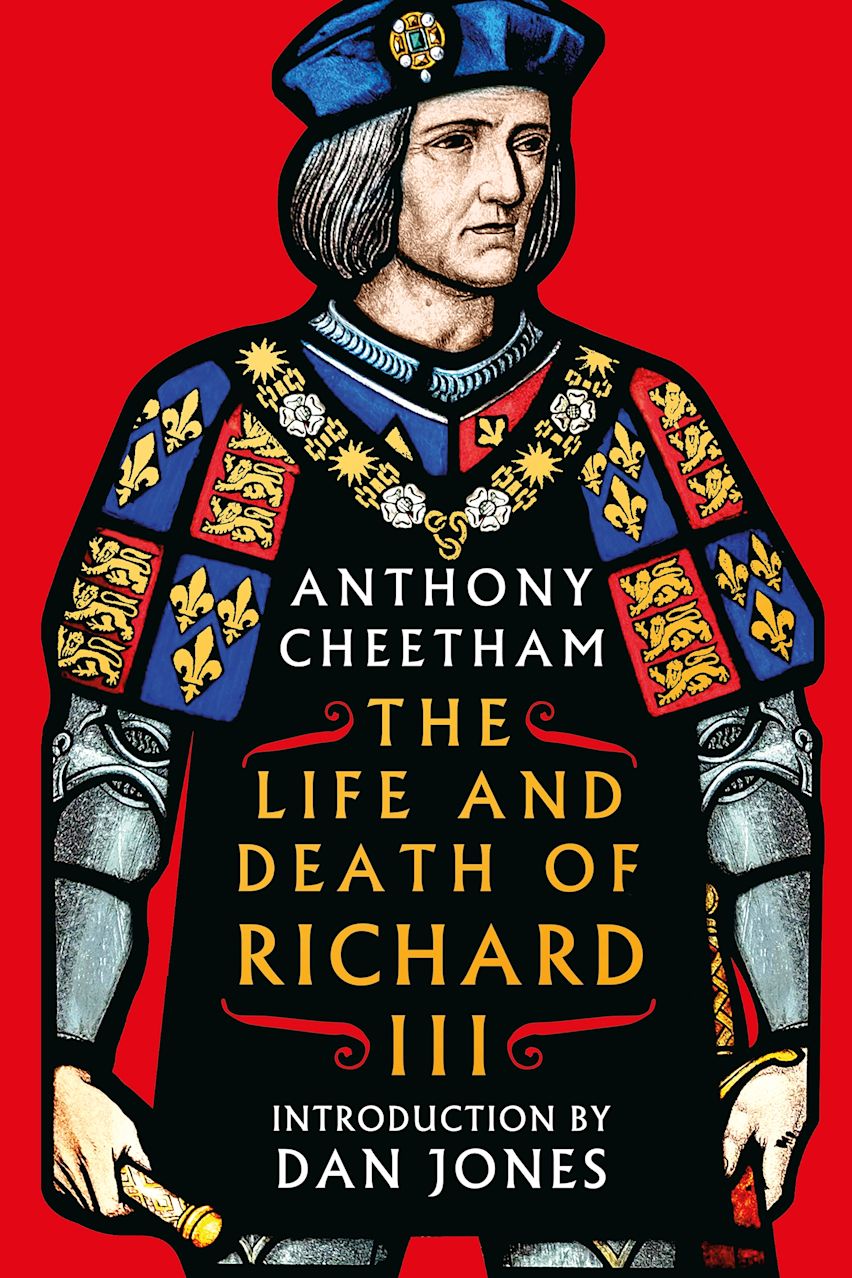
We didn’t come here for the pictures, but the production values should be acknowledged. This is a beautiful, lavish book. The artwork, photographs and illustrations from the previous edition now appear in colour and, where better contemporary examples exist, they have been updated. This is as lush and plush as can be.
But we are here for the two questions, and, to be frank, to get beyond them. The problem with the debate is that, for many, how they feel about the answer to question 1 informs their response to question 2. There is pretty much a consensus that Richard’s claim to the throne was weaker than Edward V’s. Some other historians then argue that the issue of legitimacy was a fundamental flaw and that it deserved to be. Cheetham makes the case that Richard’s failure to unite the country behind him was not solely a matter of his illegitimate crown. Once Richard’s heir had died in 1484, there was a good argument that key nobles would think they might find peace and stability at least as easily by backing Henry Tudor. Second, Richard’s poor political skills led to weaker alliances than his late brother had managed. Third, Richard had some bad luck: had he won at Bosworth which he should have been able to do, the matter of the crown would have been settled for several years.
On the matter of The Princes, Cheetham argues all points. He assesses claims that Henry VII or Buckingham may have ordered their assassination before coming to the conclusion that Richard ‘stands convicted not so much by the evidence against him as by the lack of evidence against anybody else’.
In a sense, the two questions are the least interesting things about Richard’s reign. In the fifteenth century, monarchs often dispatched rivals for the throne – ironically, it was Henry Tudor’s extremely weak case for the crown that meant he survived long enough to campaign for it – but it was the fact that The Princes were still children that has particularly captured the imagination.
I find myself more interested in what Richard’s handling of the disappearance of The Princes tells us about his abilities as a king. Richard was all about duty. Under Edward IV he had run the north with distinction, and was a skilful military campaigner. Following his brother’s death, he would have seen the stability of the kingdom as a key objective. To that end, he acted quickly and decisively. The problem, as Cheetham points out, is that Richard was a great tactician (though historians of Bosworth may think differently) but a poor strategist, who failed to plan ahead or understand the consequences of his actions. Putting out fires in the north or quelling the Scots was not the same as dealing with the Woodvilles, or the French. A more strategically-minded Richard would have thought through the implications of The Princes’ disappearance. But his problem, as Cheetham puts it, is that he had not ‘too much guile, but too little’. For all his diligence, for all his pursuit of duty, Richard, it seems, couldn’t step up to the top job. He couldn’t create unity. He couldn’t fashion a national story. Henry VII would show just how important that wold be, and how should be done. As a result, Richard’s reign must be seen as a failure in its own terms.
The discovery of Richard’s skeleton, and the resulting renewal of interest in his reign, has led to a hardening of positions between more traditional scholars on one hand and the Ricardian revisionists on the other. Cheetham’s core text was written in a slightly more nuanced time. It’s fair and balanced, and left me wanting to explore the topic more closely. Popular history can’t do better than that.
Thanks to Apollo for the review copy.
 Cafethinking