On day 4 in Tokyo I was irritable, verging on furious. I had been convinced that my cursory glances at our guidebooks, Chris Broad’s book and a primer on Japanese food would be enough, not to understand Japan, obviously, but to feel that I knew what I was doing. That day, we had visited Ueno Park to see the sakura, but so had about a million other people: it was beautiful but packed and not a place for contemplation. Fifteen thousand steps later we were in an amusement arcade, playing Mario Kart: we each won our first races, but didn’t know what button to press next, and the game was over. So I figured I was losing at being in Japan. Peter Carey’s book, Wrong about Japan, saved me that day. It’s a book about losing at being in Japan and then somehow winning. Heavens to bingo.
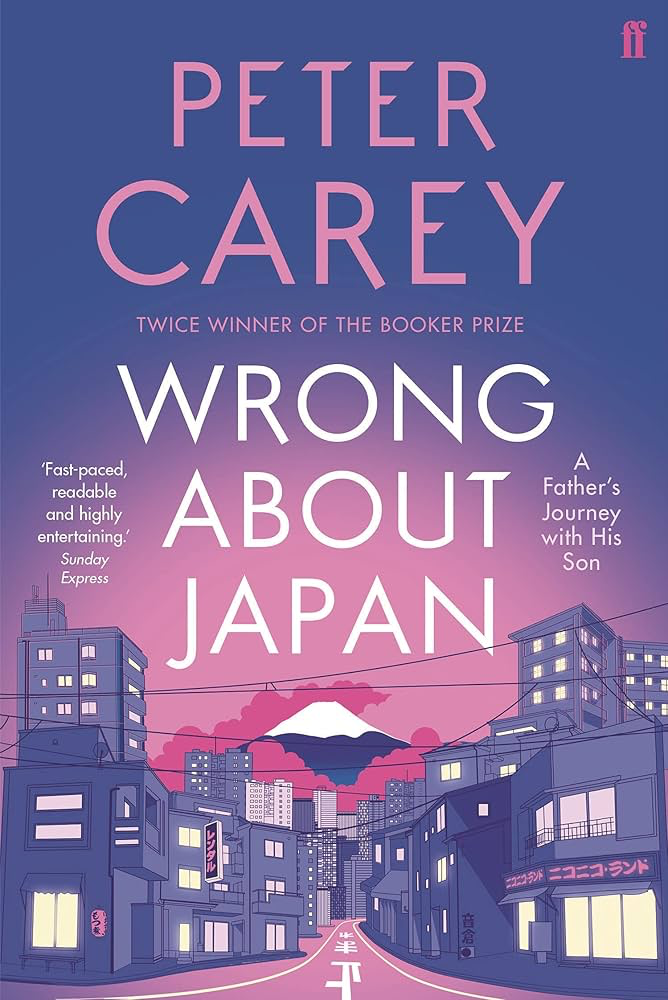
The idea is this: Carey travels to Japan with his 12 year-old son, Charley. He has made a number of assurances to the boy, which involve promising that anime and manga will feature heavily in the trip, and that ‘Real Japan’ – historical, cultural Japan – won’t. They meet Takashi, some guy that Charley has met from the internet: he signifies ‘young Japan’ and contrasts with the other Japanese the Careys meet who are adults, and cultural leaders at that: Yoshiyuki Tomino and Hayao Miyazaki.
As a guidebook, Wrong about Japan would be hopeless. Carey senior wants to explore the big, sweeping themes and doesn’t seem to have sympathy with elements of Japan he deems not exotic enough. He goes to Akihabara, the home of vast stores selling nothing but electronica (plus, as is usual in Japanese department stores, a multi-level food court), but dismisses the wares on offer as ‘mundane’ and compares the place to a bazaar from a planet in Star Wars. He misses the point of the place entirely: lost in the conspicuous consumption, he misses the innovation and the strive for perfection.
As we’d expect, Carey is an excellent narrator with a particular line in self-deprecatory humour. He is very good company. But as a result, his engagement with this society is, unlike Chris Broad’s, superficial. The main theme of the book is not Japan, its past or its future, but the story of the two Careys’ relationship and how travelling, with their different perspectives and interests, affects that relationship. Carey looks at the bits of Japan that interest him; his son does the same. They could have gone anywhere, but Japan gave them the right combination for disagreement and the finding of common territory.
This is a short book – about 160 pages give or take the illustrations. Having read half of it over a coffee, I was back to earth. I wasn’t going to ‘get’ Japan in two weeks and maybe I didn’t need to. I could be like Peter Carey and find things that interested me. I could, in fact, be me on any previous holiday. I sauntered off to wander around the Golden Gai of Shinjuku – a set of alleys featuring bars, karaoke shacks and tiny restaurants, each with a maximum capacity of between four and six customers. I looked around and I saw things and enjoyed myself. I probably won’t ever be right about Japan, but I can be right about going on holiday. Heavens to pachinko.
 Cafethinking