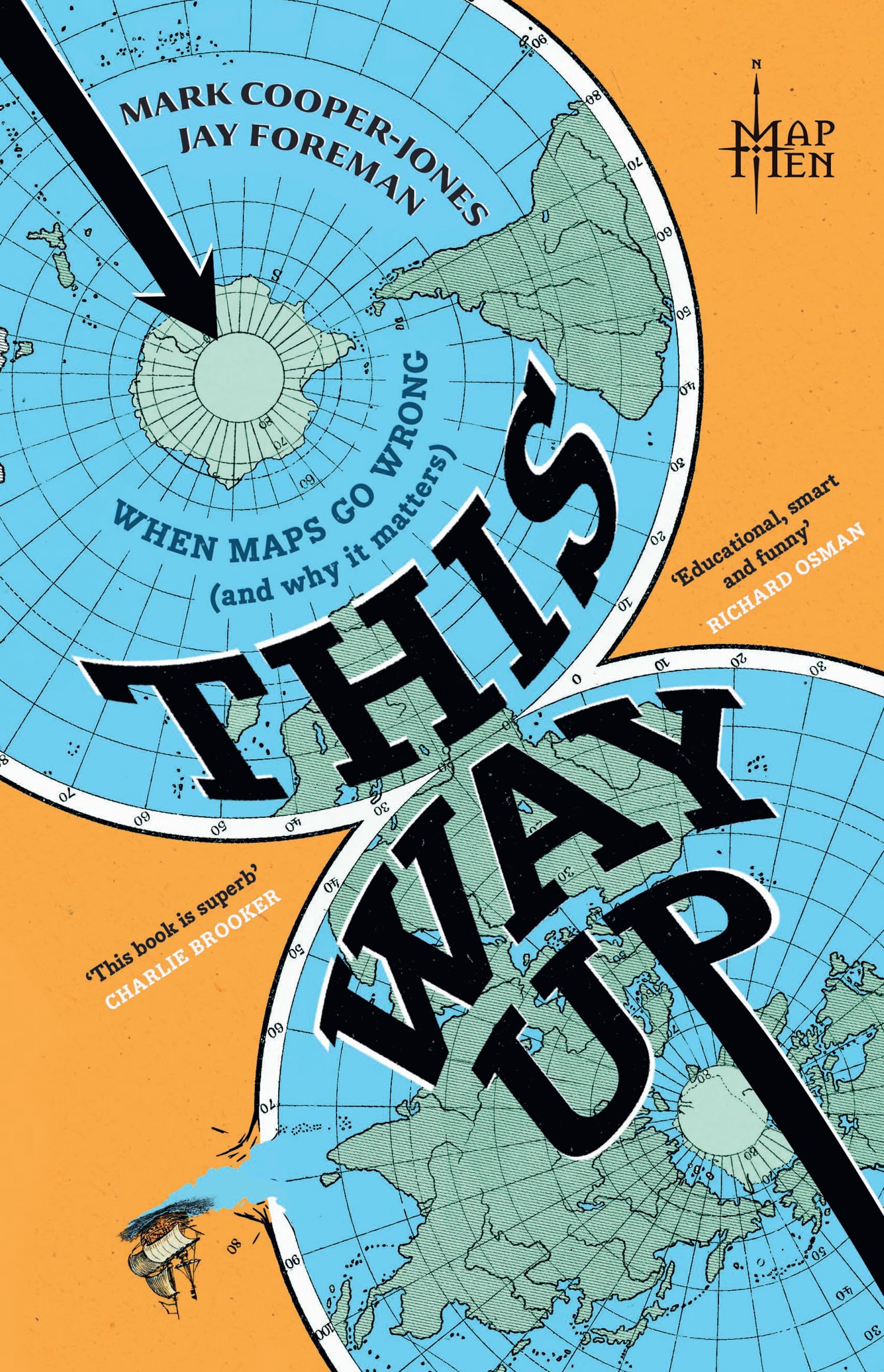
Mark Cooper-Jones and Jay Foreman are the Map Men from YouTube, but This Way Up is more than a prose version of their informative and silly videos. Though I must assure you that it is both informative and silly. The subtitle: when maps go wrong (and why it matters) leans in to a huge misunderstanding many of us have about maps, which is that we feel we may trust them. What would be the point of a map if you couldn’t? Foreman and Cooper-Jones set out how ignorance, power dynamics, greed, political paranoia and intellectual property concerns have all affected the lives and livelihoods of people who have trusted the maps in front of them.
Maps are always political. Even the most benign publication, such as the London Underground journey planner, makes assumptions about what and who is important. Accessibility information has been introduced relatively recently, and its inclusion reminds us both that the Underground should be for everyone, and that large parts of its network are not.
But that’s just the start. Lines on maps can cause chaos. Sometimes that’s because the person drawing the line doesn’t know (or care) about the actuality on the ground. See, for example, Britain’s decolonisation process. Another way to look at it is that the map user is reliant on the skills, influences and interests of the cartographer. So if you’re East Germany, you produce two sets of maps, one of which is highly classified and the other of which contains errors to confuse enemy spies and your own citizens.
The sixteen examples chosen by Cooper-Jones and Foreman tell us about ludicrous international borders that have been based on assumptions based on maps themselves based on assumptions, topographical features such as mountains that were completely made up, or a town that exists only because it was included on a map because it didn’t exist. Some of these stories have been tackled on the Map Men YouTube channel, but one which hasn’t – and my reason for buying the book – is its coverage of the ITV regional map.
ITV, for readers outside the UK, is the country’s oldest and most popular commercial terrestrial TV channel. When it was introduced, from 1955 onwards, it took the form of regional franchises. There were 14 regions, ranging in size from London to the tiny Channel Islands. (Just for fun, London (and, at first, others) had separate weekday and weekend franchises.) Depending on where you lived, you would associate with Yorkshire Television, or Anglia Television, or wherever. During the second half of the last century, your ITV region became a powerful source of regional identity. (These days, that regional identity has almost completely disappeared due to mergers and takeovers that were legalised in the 1990 Broadcasting Act. Something has been lost in the process.)
Cooper-Jones and Foreman point out that the whole process was untidy, because of the need to site transmitters for each region to meet topographical requirements, but some of the issues were political – I hadn’t previously realised that the Yorkshire region misses out much of North Yorkshire but cuts into Norfolk and Cambridgeshire (Anglia territory – and the reason for this was a bust-up between Yorkshire Television and Tyne Tees Television, neither of which has any business in determining TV programming in Cambridgeshire and Norfolk) – and they touch on what many people believe was revenge by the Thatcher government on the highly-respected Thames Television, which had produced a documentary that was uncomfortable for the prime minister. Did I mention before that maps are about power?
This last paragraph is incredibly nerdy, but I present it as evidence that much of this topic is nerdy. I regret having read the book in one sitting, because there is much to dwell on. Cooper-Jones and Foreman use different formats for each chapter, mixing up the humour so it doesn’t grate, but there’s a lot of material to enjoy, imbibe and tell people about. Just remember, when you’re holding the book, which way is up.

