Contains mild spoilers
After the rough-and-tumble fusion of farce and fury that constituted London Rules, Joe Country takes us in a quite different direction: west. The main action in Mick Herron’s sixth Slough House / Slow Horses novel takes place largely in Wales, but in case we’re wondering that this might leave the British establishment to its own devices, the spooks have only gone to play an inadvertent role concerning a scandal involving the royals and perennial panto villain Peter Judd. And against those forces, and others, we once again learn to root for the underdogs.
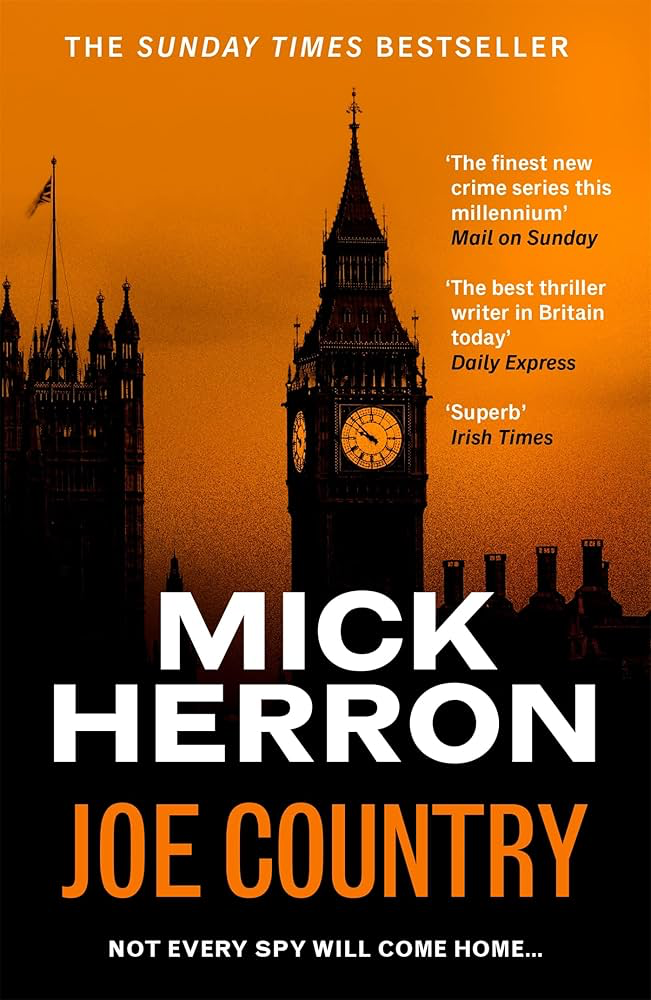
It doesn’t help that the front and back covers of Joe Country warn us that ‘they’re not all coming home’, and that the opening pages intimate that a man and woman have been killed. We all know that Herron reserves the right to trim the team, but the news that not everyone will make it gives the novel a menacing edge that is almost overpowering. I have re-read this book, and found it easier (and more interesting) to splash about in the novel’s differing layers than when I was speeding ahead to know who had made it back to the Barbican.
Many of the characters spend the early part of the book in states of grief: River for his grandfather and Shirley for Marcus, and we are reminded of Min, deceased colleague and Louisa’s ex, when his ex-wife reaches out to Louisa for help in finding their missing son, Lucas. For the second novel running, the horses sort-of pair up. Louise and Emma Flyte (not a horse) make a great pairing in pursuit of Lucas. River, Coe and Shirley follow them to Wales, but not before David Cartwright’s funeral is disrupted by River racing in hot pursuit after his estranged father Frank Harkness who is observing the burial. Will River ever take a moment to plan tactics, let alone strategy? The OB would have been disappointed. Harkness, on the other hand, has some grudging respect for his son and gives Cartwright senior some praise when he notes that the late spook would have provided better security for the funeral than his professional successors.
For while the horses are running and jumping in the Welsh snow, different battles are playing out in London. Diana Taverner is trying (not entirely successfully) to politically outwit her civilian oversight, and leaves herself open on other flanks. The saga of the German BND placing a mole into MI5 which was the focus of the novellas The List and The Drop has made it into the main series, and the result is the appearance of Lech Wicinski at Slough House. Wicinski has been set up by the Germans, and the Park could work all this out for themselves but for the fact that the officer who could solve it if he wanted it doesn’t see it in his own best interests to uncover the truth. Wicinski gets it from all quarters, including Jackson Lamb, although the anti-hero does find a grim way to resolve some of the issues. Don’t expect Wicinski, or anyone else to find inner peace in this bleak novel. The nearest to managing it is J K Coe, who holds what might almost be a normal conversation, were it not with a mercenary gun for hire.
That gun for hire, by the way, is working indirectly for Peter Judd. Many of us have assumed that Judd is a lightly disguised portrayal of Boris Johnson. At the time Joe Country was written, Johnson had resigned from Theresa May’s government but was not yet nailed on to replace her as prime minister. Herron has Judd take up a role as an extremely unethical (and, obviously therefore inauthentic) PR agent. It’s interesting to see the differing operational approaches of Judd, Taverner, and Park official Richard Pynne. Pynne is a wretch of a man who will remind readers of Spider Webb. His inner narrator tells us that you don’t lie to Diana Taverner unless you are sure you can get away with it. When he does lie, later on, he will set in train his own downfall. Taverner sees power as performance: she schemes and connives but although she makes clever moves it’s not always clear that they’re against the right enemy. Judd, of course, is always the right enemy. He’s more strategic, through this is a function of his low cunning, boredom and rampant narcissism. The damaged Lamb, as we know, is no philosopher king. Herron declines to give us a positive role model to contrast against these knaves and misfits.
When the much-seeded deaths occur, there’s a kind of reckoning. But other than Catherine Standish who faces and conquers her demons once again I can’t think of any characters who are better off at the end of the novel than at the beginning. This is bleak, angry, funny, unmissable fiction that rewards re-reading and if that seems a little contradictory, well, that suits the Slow Horses down to the ground.
 Cafethinking
[…] Joe Country […]
[…] (though Bachelor and Taverner are also complicit), and we’ve seen Pynne act disgracefully in Joe Country. So we aren’t too disappointed to see that he’s been cast out from his position as Taverner’s […]
[…] Junction anthology. If you’re trying to read everything in order, you should pick it up after Joe Country – but sources differ on whether you should read it before or after the novella The Catch. (I […]