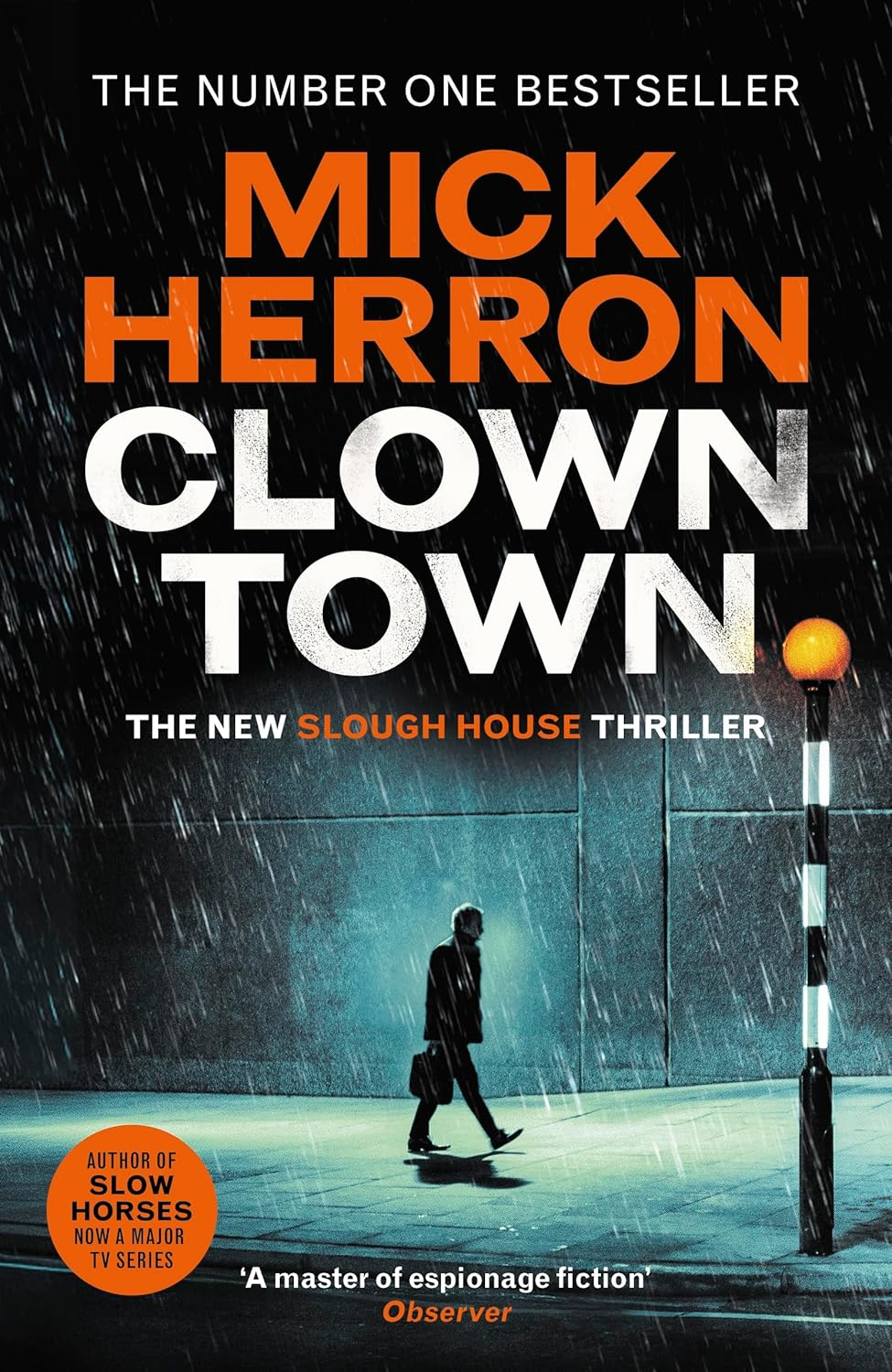
And, we’re back. Following The Secret Hours’ visit to Berlin and to Jackson Lamb’s past, Mick Herron brings us right back to the present in Clown Town. It’s like we’ve never been away. Keir Starmer may now be prime minister, and in a new twist there may be actual mention of contemporary political figures such as Truss, Farage and Cummings, but Diana Taverner and Peter Judd are still jockeying for personal advantage. This can’t go on, and Clown Town explores a number of ways in which the matter might be resolved. That these involve harm being caused to bystanders, and that the slow horses are put once again at risk, will not surprise any previous readers or watchers of the Slough House / Slow Horses series.
Herron’s not impressed by the new government, and offers derision, but his real contempt remains for the UK’s last leader but two. We sometimes get the sense that Herron regrets making certain career choices for Judd that steered him away from Downing Street, although describing what Judd got up to instead is considerably more damning. This time, Judd puts pressure on Taverner to commit treason, plans to make a move on his daughter’s friend, and is compared, philosophically, to a squirrel. It’s not that all this isn’t entertaining, but even I found it a bit much. I have had twenty years of having had enough of Boris Johnson. Taverner is right to seek ways to finish this, even if her strategy is both full-on and cack-handed. And of course, Judd has the right to take his own steps to win out.
But Taverner is not the only one who is seeking closure. The former members of the old Brains Trust team of retired spooks are aware of having been cast aside. Louisa wants to get away from Slough House, and has options, but it is not much of a spoiler to assume they won’t be taken up. Ash, Lech and Shirley wish to leave too, but they are aware that there isn’t really anywhere they can go. Ho has a task to do that makes me picture Professor Peach in The Italian Job. He’s not going anywhere but it isn’t clear that he understands where he is in the first place. River, who has been absent since his Novichok poisoning, is desperate to resume his role in protecting the nation, and his partner, who wants him to leave, is prepared – at least, at the beginning of the novel, to put herself in danger so that he can resume his role as, as Lamb puts it, Uh-oh Seven. In this pursuit, River will act now and ask questions later. He will, in short, show that he has learned very little over the last nine novels.
There are clues to suggest that Herron is beginning to set us up both for the collapse of the Park and/or Slough House, and for some kind of resolution, if not for the horses themselves, then for their leader. Lamb and Catherine share a moment. Recent events have been upsetting and Lamb’s sarcastic deflection lands especially badly with Catherine. She asks if his heart ever breaks and his answer is more revealing than almost anything he’s said so far: ‘If I let that happen, I’d have to walk away. And it’s a long time since I’ve had anywhere to walk to.’ He is, as usual, the protagonist. He doesn’t want to get involved until the horses are in harm’s way, and then it falls to him to take care of business.
I haven’t gone back to check, but does Herron, who is always keen to provide a metaphor, get even more creative than usual? For example, the four of them sprawled across three sunbeds like an exercise in fractions. Lamb’s running gag this time is that he presents malapropisms, which when picked up, he defends. Then, at the end of the book, he tells Catherine how much he loves metaphors. It feels like one of Herron’s slightly meta asides, such as his references to the TV adaptations. See, for example, when Lech returns from lunch to hear Roddy crooning, ‘Loser and boozers. Something something fingernails.’ Lech: ‘Working on your theme song?’ These, it should be said, work better in the wild, when you aren’t expecting them, than when they are set up with the promise ‘See, for example’. But it’s been a long day.
The publication of a new Slough House novel sees us pose two questions, one of which is asked of every novel. What will happen? The second is: What will Herron do on the page? At some point, that tatty office in Aldersgate is going to need new tenants. When that happens, I’ll be all at sea. But I can’t wait to see the developments that cause it expressed on paper.
Thanks to Baskerville for the review copy.


[…] return to his grandfather’s house just plays with us. If you want to know whether River survives, the answer is here. But in some ways the cliffhanger is just plain annoying. It takes us out of the story, and leads to […]
[…] Did River survive at the end of Slough House / Slow Horses series 6? You won’t find out below, but if you really want to know, the answer’s in our review of the following book, Clown Town. […]
[…] If you’re a fan of the Slough House world, you should definitely read this. Do so after Standing by the Wall and before Clown Town, to which, refreshed, I now return. […]
Wait so… there will be another season of the TV series?