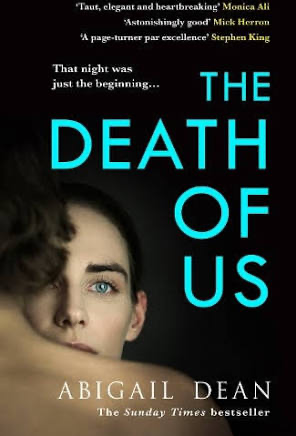
I bought The Death of Us by Abigail Dean, because it was my birthday and the dedication read For Richard, with love. I can be shallow at times. The irony is that The Death of Us features two of the most interestingly-drawn characters I’ve met in a while. Isabel and Edward meet in 1990. But on 26 May 2001 they are attacked in their home, by a serial killer and abuser. By 2025, the ‘South London Invader’, Nigel Wood, is on trial. Isabel and Edward, whose marriage did not survive the aftereffects of the attack, attend the court, to give their victim statements and to witness the sentencing. Little by little, Dean tells the story of the last 35 years: how Isabel and Edward were, how they grew together and then apart. It’s compelling and unusual.
Dean uses a variant on the dual-timeline narrative. Chapters titled ‘Edward’ are written in the third person and are mainly set in the present day. But the chapters titled ‘Isabel’ are different. They are written in the first person and are addressed to Nigel Wood. Isabel is telling Wood her story – at least from 1990 onwards. We learn that Isabel and Edward are accomplished, and talented in their chosen fields. Present-day Isabel makes it sound as though 20-something Edward and Isabel are pretty unpleasant. But 50-something Isabel and Edward are not that much nicer.
Isabel’s story is fascinating. She talks about herself in a way that is in some ways self-reflective but in others completely not. She’ll talk about their domestic style as being pretentious, with Le Creuset pots and copies of the New Yorker. She shows no general regret, but neither does she set out of justify her actions: there’s explanation but that’s not quite the same thing. She also credits Wood with a certain level of empathy and emotional intelligence.
I wasn’t expecting a twist, exactly, though a more attentive reader might have worked out that there would be one, and what it would be. Twist there is, and it is utterly earned, rooted in Isabel’s profession as a playwright and TV writer.
‘This is a story of love,’ says the book jacket, and it’s striking how few characters are really explored. We learn very little about Wood (not that we are particularly interested in him). There are university friends, fellow victims of the Invader, a policewoman and a teenager. But they are all minor players in the story of Isabel and Edward.
Compared with some of Wood’s other victims, Isabel and Edward might seem to have thrived. But they were separated and treated differently in the attack. They can’t come together to forge a common truth and their trauma leads them in different directions. Edward feels guilt, which drives a further wedge between them. After a few years, their relationship is all but over, but they struggle on a bit longer until the issue is forced.
But talking about the storytelling and the plot is almost to miss the point. This is a tale of two people who are meant for each other, who in some ways glitter but who are in other ways quite ordinary. Their lives are torn asunder and their love is not enough to help them navigate the new circumstances in which they find themselves. Wood’s trial and sentencing might be their last and best chance to achieve some kind of closure, but whether the closure will involve participation in each other’s lives again is the theme of the novel.
At times The Death of Us is outrageously good. It’s confident and bold. It gives its two lead characters the space to be messy and warm and petty and unkind and generous and flawed. I think that it’s excellent.

