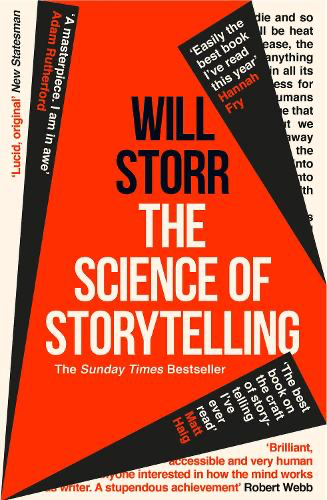
Everything you’ve ever heard about storytelling has been as true and as false as you allow it to be. This is both frustrating and a matter of great relief, and which you choose it to be is a matter of character. That’s the conclusion I draw from The Science of Storytelling: Will Storr’s exploration of the neuroscience and psychology behind our interpretations of storytelling. In the process, I wonder if I have wrung some of the joy out of reading fiction. But you had better believe that I will be wondering which of the lessons I can apply to non-fiction and any writing I might happen to do within business hours. Storytelling is the current big fad within the c-suite, and you do have to wonder where these people have been. Storytelling is, after all, as old and as central to power and civilisation as the cliched hill.
Storr’s central premise is that our cognitive ability is based on what we need to know. That’s why, for example, our eyes recognise three colour cones, when other animals can deal with more. Through the generations, we have learned to interact with other brains. Stories became the way in which early humans set the rules of the tribe. At the same time, our brains develop to make us feel as though we’re the moral heroes of our lives. In that pursuit, we will dismiss evidence that makes us feel less in control or damages our central view of the world, and we will kid ourselves that we are in fact driven by evidence and the truth.
Storr describes facets of psychology – we learn about domains of personality – and uses largely Western examples to illustrate his points, from the Old Testament to The Godfather. Now, this would make sense given that Storr is writing for a UK audience and pulling together material from a course he teaches, presumably, again to a UK audience. But I found it particularly fascinating when he dropped in the occasional non-Western example to prove differences in what different cultures call for from their storytelling, so it would have been great to have had this explored in more detail.
It’s also a good job Storr has called this book the Science of Storytelling. There’s science, and storytelling, and science behind storytelling, but not much storytelling about science. I know many of the books, films and plays Storr talks about so there’s credibility from that (though had I not known of them I’d have found that aspect of the book hard going) but not the neuroscientists he talks about. My brain doesn’t really feel in control, even though that is what I am being told it wants to be.
And yet, unless I’ve missed something, where we end is the understanding that neuroscience and psychology support Christopher Booker’s seven recurring plots and the five act theory for fiction. The special sauce Storr is adding on top is the reminder that we are more interested in people than the things around them – the ball in Madame Bovary is interesting because of its effect on Emma. In itself the ball is of no interest. (In fact, of course, the ball could be of interest in a number of ways but only if we know what happens to people as a result.)
I’m left with thoughts wandering in a number of directions. (First, I want to read more about the source document Shakespeare used for King Lear. It looks as though Kenneth Branagh may have got Lear all wrong.) It feels as though Keir Starmer, who resolutely sets his face against story-telling, may, from the five act theory, be writing his own tale to be a tragedy. Second, for those of us who seek to make the case for causes, there’s a reminder that it simply isn’t enough to be right. (Though you had better make the effort to be right anyway.) And two songs come to mind. In My Land Is Too Green, Mary Coughlan once sang, probably about the Irish Taoiseach Charlie Haughey, ‘We all love a rogue and we’ll make him our leader’. And, more famously, Tina Turner: ‘We all need another hero.’ Turns out it was a matter of science all along.


[…] remain so for a little while longer. But everyone knows the game is up. Recently this blog covered The Science of Storytelling and predicted that Starmer’s story would turn out to be a tragedy. Get In shows all five acts. […]