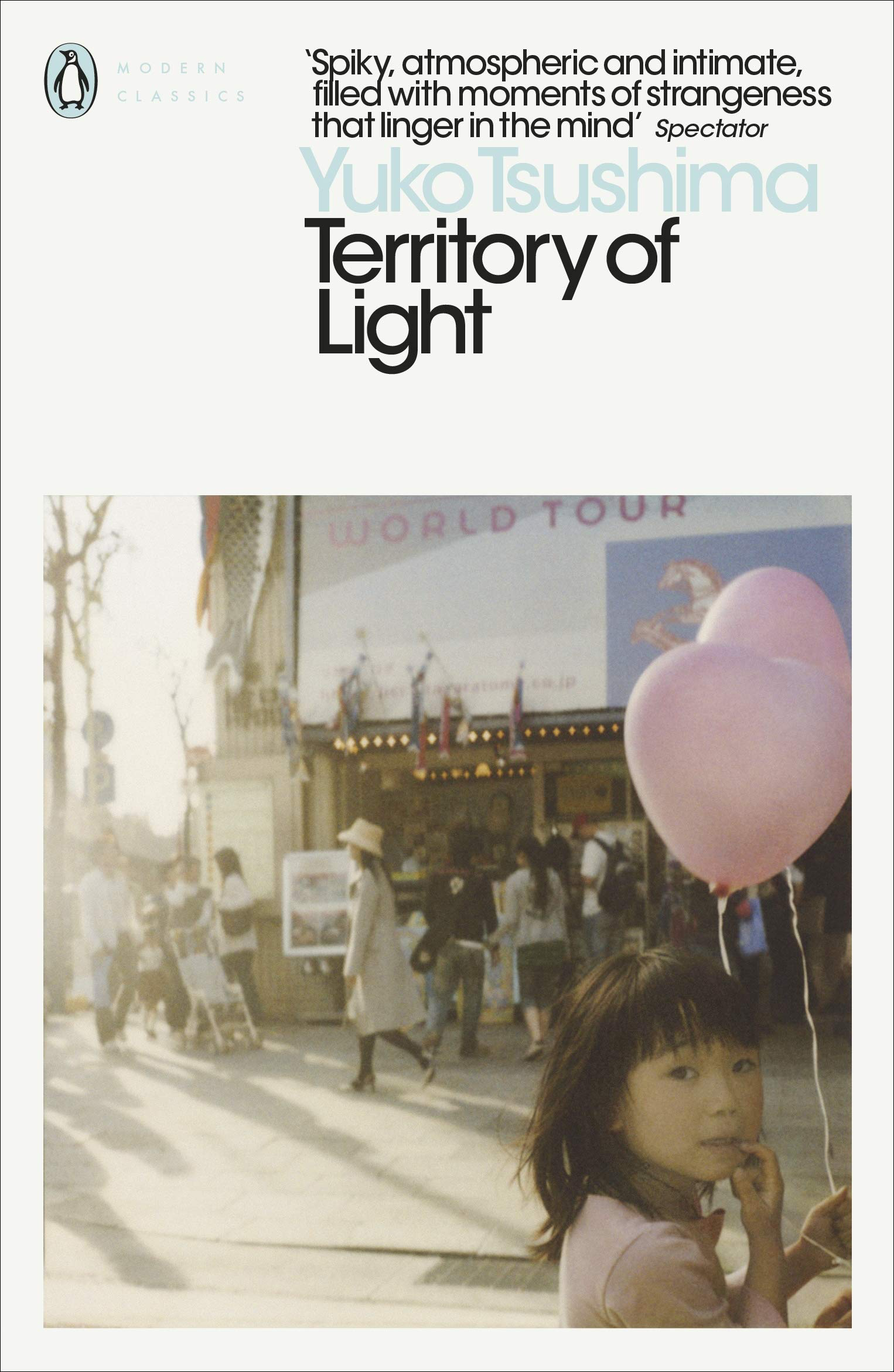
The Penguin Modern Classics edition of Territory of Light by Yoko Tsushima, which contains the translation by Geraldine Harcourt, has on its front cover a colour-bleached photo, presumably of late 1970s Tokyo. In the bottom right hand corner is a young girl, glancing inquisitively at the camera and holding two pink balloons. If you bring balloons to this novel, cling to them tightly. You will emerge from the other end somewhat discombobulated and somewhat angry.
Over 122 pages you’ll read 12 short stories which together describe the year of a young single mother and her toddler daughter as they navigate their way through a world that couldn’t care less about them (and which, in fairness, it’s not that clear that they care that much about either). A feature of the novel is that we never know the name of either the mother or daughter; it’s as though their identity is irrelevant to their own story. It feels strange to observe intimate details of a life lived on the edge of society through a gaze that is highly anonymised.
In the opening pages, Mother is looking for an apartment for Daughter and herself. Fujino, the outgoing husband, and a snivelling rat of a man, wants the two of them to move back to Mother’s own mother’s: ‘with you two at your mom’s, I could leave you without worrying.’ But Mother finds an apartment on the top floor of a building (which happens also to be called Fujino), which is flooded with light at all times of the day. This will be her territory. They will live there from sakura season until the same time the following year.
The individual stories are a series of snapshots: there is progression but it is not linear. Mother is an interesting narrator: she has a keen sense for the detail of self-observation but not self-awareness. She is matter-of-fact in describing her successes and failings, but her story-telling is descriptive, not analytic. As a result, she’ll talk about actions she undertakes that may or may not succeed but there’s no sense of whether she’s glad or regretful. Since many of said actions involve Daughter being put in danger, or impetuous conversations, a picture emerges: of a woman lonely, angry, confused, resentful, impulsive, depressed and exhausted. For all the light promised, the apartment brings darkness and unhappiness.
We want Mother to succeed on her own terms, we really do, but I wonder whether that’s because we’re reading this in the UK of 2026 and not the Japan of 1980. Fujino’s appalling character is almost a caricature, such is his selfishness, sense of entitlement and fecklessness. (But between 1980 and now, similar people have risen to positions of power even in our own land, so we should have a bit of humility.) Such was the culture at the time that Fujino none the less had envoys make the case to Mother that she should take him back. We assume that they are acting on his behalf, and yet Fujino himself shows no interest in saving his family. He doesn’t pay child maintenance, he doesn’t turn up for counselling. And yet we know that there are times when Mother would have taken him back if only out of a lack of a plan of her own.
We get the impression that the building is holding her back: that the magical possibilities of a territory of light are too overwhelming. In the autumn, she describes a fire involving another single mother she’s had an imaginary friendship with, and links it to filing for divorce. But it is only when the divorce comes through and she’s able to change her name from Fujino that she suddenly is liberated enough to leave the apartment of that name. She is able to set her own course. It is only in a place where shade is as possible as light, that real recovery can be made.
Thanks to Penguin for the review copy.

