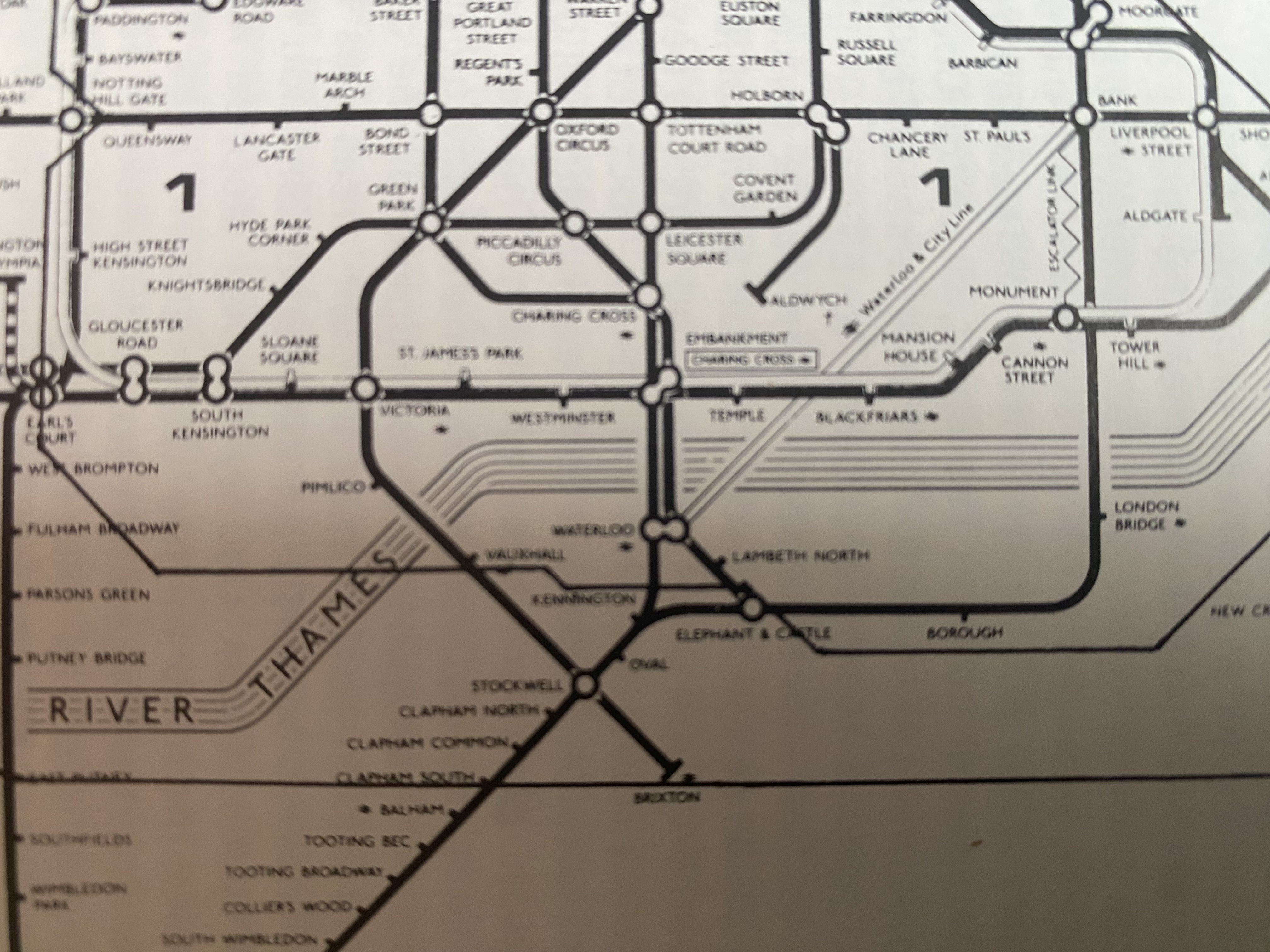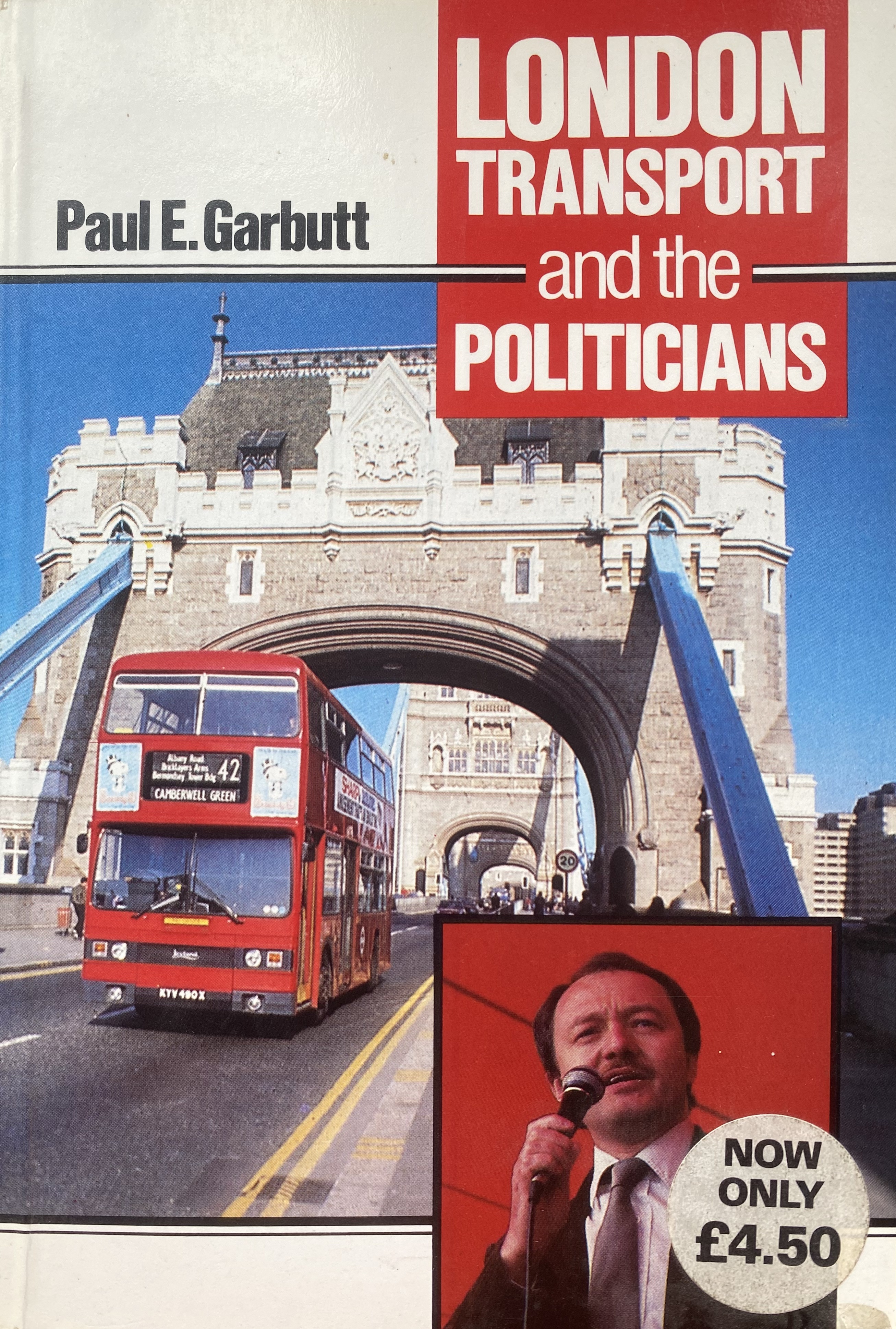
Paul E Garbutt is an underground hero – a London Underground hero. He rescued the tube map in the mid-1960s after a few weird years in which the smooth principles of Harry Beck had been replaced by jerky angularity. It was he who gave the Circle line its flask-like shape: since then, most other lines have changed their shape and flow on the map but the Circle’s flask is one of the few constants. It was under Garbutt’s guidance that Londoners first saw the Fleet, later the Jubilee, line take shape, and the Piccadilly line extension to Heathrow. The map designer sets the context in which the travelling public experience the civil engineers’ achievements. It was not the civil engineers but Garbutt who had a poem written for him in Jan Mark’s Zeno Was Here. So I was glad to find a copy of Garbutt’s book London Transport and the Politicians, published in 1985 and covering the turbulent period from 1964 until the abolition of the GLC and the creation of London Regional Transport (LRT).
Garbutt was a senior manager at London Transport (LT) during this time, with a stint as chief secretary to the London Transport Executive. He had a ringside seat during what was probably the most turbulent time for London’s public transport system. The rise of the car leading to worsening bus unreliability, staff shortages, macro-economic issues leading to falling real revenues – these were the real problems facing the network. But there wasn’t at the time a consensus about how public transport should be organised and financed. London’s system had to pay its way to an extent unimaginable in similar Western cities. Given the resources available, the task was too big for the GLC, and successive governments at Westminster had their own fish to fry. Instead, GLC leaders bickered about staff perks: red meat for populists on the right then and now. Labour administrations would try to keep fares low, Conservative ones would let them rise but might do more in terms of capital expenditure. But what John Carvel once described as ‘modest dollops of subsidy’ were simply not enough.
At 128 closely-typeset pages, Garbutt’s account is fairly short and punchy. It’s easy to get the sense that things were hard to control. Members of the Board and the Council had big personalities and these were not conducive to smooth management. Self-publicists such as Leslie Chapman got in the way of the cost-cutting they claimed to encourage. Garbutt’s own assessment might have seen this book more accurately titled London Transport versus the politicians: certainly Garbutt believed that if only the professional managers could be left to get on with the job then LT might have weathered the seventies and early eighties rather better. He points out that the scythe taken to senior and middle management in the early 1980s could prove counter-productive. At the time that Garbutt was writing, LRT’s nadir, the Kings Cross fire that showed a shoddy and complacent corporate and safety culture, was still two years away.
It’s quite possible to suggest that the twenty years leading up to Kings Cross saw management’s time diverted to the wrong things – but I’m not sure that the case has been proven one way or another. Gordon Brown’s distrust of London Underground’s ability to deliver big investment programmes led to the disaster of the Public Private Partnership. TfL’s culture may be unrecognisable from those times these days but we get the public services that we vote for.
Garbutt is more or less critical but fair towards the GLC administrations before 1981. He does not bite his tongue about Ken Livingstone’s time in charge at County Hall. As a result his critique of the Fare’s Fair campaign (in a nutshell: Labour group cuts fares significantly as per its manifesto, Bromley Council takes them to court, wins, as a result fares rise by 96% before Labour have another go) feels less even-handed than his other analysis. Garbutt fears that an ‘off-beat or extremist’ Board chair might be appointed, he tuts that the GLC supported ‘dubious and sometimes bizarre fringe activities’, he frets that the GLC nominated to the LT Board a ‘female lecturer’ and a ‘lady writer’. Finally, he suggests that had Livingstone been less ‘immoderate’ the GLC might not have been abolished. There’s no doubt that as a senior manager, Garbutt found little common cause with his political bosses at this stage. I can’t decide whether it’s helpful to see that tension play out or whether it detracts from Garbutt’s authority. Either way, it’s a reminder that recent spat between the Government and City Hall over post-Covid funding for services in London is nothing new: in the 1970s and 1980s politics was everything when it came to the funding and the management of London Transport.
One final note: as I’ve mentioned Garbutt rescued the tube map. By the 1980s there was a short lived version of the map, which I don’t think Garbutt produced. With rather more right angles than Garbutt’s work of the 1960s and 1970s it didn’t last. It’s hard to find on the internet and though I kept an eye out in a recent visit to the London Transport Museum depot I didn’t see a copy. But there is a black and white version in Garbutt’s book. See the area around London Bridge, and the diagonal Aldwych branch.