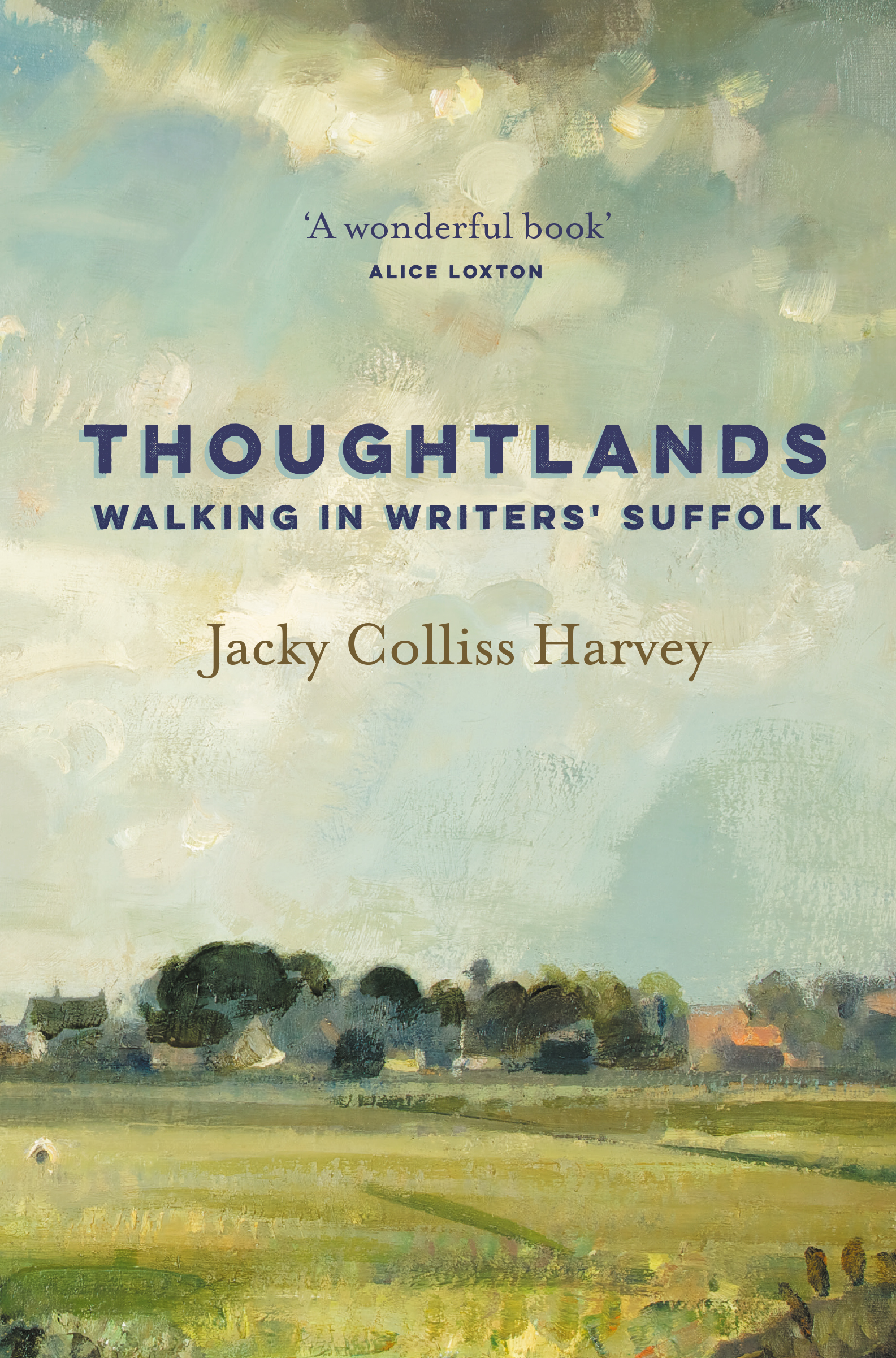
Recently, we have been working our way through Suffolk Outstanding Circular Walks, an Ordnance Survey Pathfinder Guide. Our current score, which is exactly the wrong but also the right way of looking at it, is 18 out of 28 walks completed. Then I came across Thoughtlands: walking in writers’ Suffolk by Jacky Colliss Harvey, and the walking has been put on hold so that remaining adventures have the benefit of Colliss Harvey’s insights. Which is, again, both the wrong and the right way to proceed. This is a short book but a long read. It will send you in lots of different directions, but you will be in your mind rather than on your feet.
Part of what makes walking special is that there are multiple layers of content. Is there purpose? If you are enjoying circular walks, they may be primarily pleasurable – but not necessarily. Poets, Colliss Harvey tells us, like to bang out a meter, to impose subsequently on their creations. I have been known to bang on about the economics of rural areas, or provide updates (phone reception permitting) on football matches, which may or may not be pleasurable to companions. Other subjects for conversation are available. That is before we even consider the landscapes, birds, animals etc. (There is one guarantee: if Suffolk Outstanding Circular Walks offers a particular bird, or perhaps otters, to be found on a particular route, you may find other delights but you will look and listen in vain for those promised.) I may follow you on a route an hour later but we will have vastly different experiences.
I mention all this because walking, says Colliss Harvey, is key to the human condition, ‘the driver in our evolution’, which is good news as we try to set ourselves apart from artificial intelligence. At first, I’m not sure I’m buying this, especially as on many of her walks she is accompanied by a dog, but she brings it home when she asks ‘when did women walking become a thing’. This is perhaps the most political sentence of the book as it reminds us about access to the countryside and who can make it part of their story and who cannot. This status changes and it cannot solely be a matter of long-understood codes and mores. Jenny Riddell-Carpenter is onto something, although she expressed it badly.
I wrote above that this was a longer read than I was expecting. This is mainly because I kept stopping to look things up that I realised I knew less about than I had thought: the story of Dunwich. The playground favourite straight outta Lavenham. (Spoiler: it’s Twinkle Twinkle Little Star). The little lost hamlet just south of Aldeburgh. And I’ve downloaded a birdsong app on the back of this, too. Colliss Harvey loves a diversion, and many of the happiest moments in the book come from an aside or a sudden dive into an explanation of a particular author’s relationship with a place. I will look at the George Orwell mural on Southwold Pier differently from now on.
There is both more, and less, history than you might think. There are a few writers whose involvement with Suffolk I didn’t know. But Colliss Harvey leans heavily on ‘Smasher’ Dowsing, the puritan iconoclast, and while Dowsing will have affected the fabric of so many village churches, I’m startled by the lack of more recent stories. (This is, of course, a reductive and inaccurate way of looking at history, at walking, and at the countryside.) But we do get that sense of place, of something larger than ourselves but something we are none the less part of, and we see how writers and writing have, in some way, if not quite affected the landscape (though that is possible), affected the way in which we look at it.

