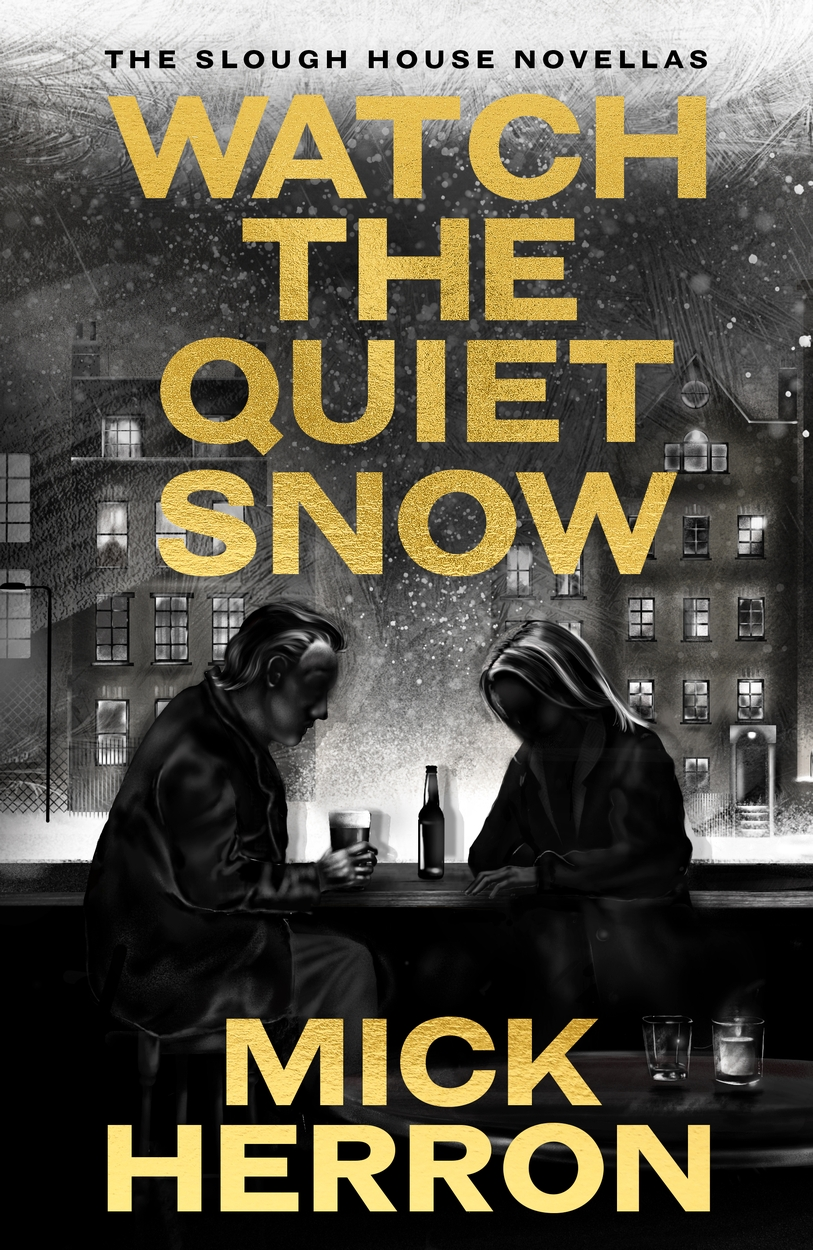
Mick Herron is doing very well right now. Series 6 of Slow Horses is the number 1 show on Apple TV in numerous countries. With a tenth Slough House novel not arriving any time soon, and the bumper Christmas sales period coming up, what is a publisher to do? Baskerville’s answer: Watch the Quiet Snow, an anthology of five novellas all set within the Slough House world and previously published between 2015 and 2022. You might think of this collection as a ‘mixes and rare grooves’ album that a band’s record label might put out between studio-recorded releases. And given that some of these novellas have in the past taken some effort to track down, and that the packaging (dust jacket and endpapers) is rather lovely, this will be a choice for general fans as well as completists.
Baskerville now markets the novels Nobody Walks and The Secret Hours – and these novellas – as ‘Slough House standalones’ whereas previously their relationship with the main novels was unacknowledged.
But a fundamental question arises about how these stories should be consumed. This blog has covered all of the novels (with the exception of Reconstruction) and novellas, and, they have been read, and reviewed, in order. The List, for example, sets up Nobody Walks which in turn sets up Real Tigers. Its main relationships are with the novels around it, not with its fellow novellas. So it was interesting to re-read the five novellas one after the other.
If there is a story arc, it is the story of Mick Herron as a writer. Herron flexes his muscles and tries different things. The first stories give examples of non-Slough House spookery, and we get a sense of the work of Taverner and co which we don’t see in the main novels. Taverner knows everything; Bachelor knows next to nothing. Both triumph, to the extent that Bachelor can be said to triumph, by working the system, though there is some analogue tradecraft to follow. Eventually we realise why Taverner keeps Bachelor around, and the incentives and motivations that drive men like Pynne. Astonishingly, Bachelor resents Pynne for a decision Taverner made, one which had it gone the other way would have been curtains for Bachelor’s career. But pride goes its own way. I’m not sure that we can deduce that Bachelor has learned much, but Herron is beginning to revel in the opportunity to paint in different tones and provide a different narrative mood.
The fourth story, The Last Dead Letter, is quite different: the first time Herron starts to explore what a Jackson Lamb origin story might contain. He’s very careful in all his writing to allow the reader no access to Lamb’s thought processes. Here, it’s a speculative narrative provided by Molly Doran that tells the story, with occasional grunts from Lamb. I wonder whether this helped shape Herron’s approach to The Secret Hours, much of which involves Lamb in Berlin.
And the fifth story tries something that is again completely different. You could argue that the appearance of a character largely missing from the novel preceding it gives us a bit of fan service. But if the first few novellas had Herron try to turn down the overt humour, in Standing by the Wall he makes up for it. No potential seam is unmined and if Lamb summoning Roddy ‘like an angry Santa’: ‘Ho. Ho! HO!’ feels a bit lowbrow, well, it follows an excellent paragraph about Roddy’s self-delusion which also involves him falling over. It’s a fun Christmas story (but which, again, makes an excellent segue into The Secret Hours) and if Baskerville are hoping for seasonal sales, that feels like a very happy coincidence.
In giving this collection the subtitle: the Slough House novellas, Baskerville set an expectation that there perhaps won’t be any more. My own view, based on nothing other than my reading of the ending of Clown Town, is that there’s one more main novel left. This subtitle suggests that this is it for the novellas. I will be delighted if I’m wrong. I will be less delighted if there’s a further repackaging of these stories.
I enjoyed revisiting these novellas, and coming on the back of series 6 it was quite nice to have to deal with different dysfunctions. But all that has happened is that I now want to revisit the earlier novels. If you are a collector, or did not have all of the novellas included, this is a useful volume. But if you can read all the stories in the right order, that would remain my recommendation.
Cafethinking’s coverage of the individual novellas:


[…] Last Dead Letter also appears in the compendium Watch the Quiet Snow, for which there is a separate […]
[…] by the Wall also appears in the compendium Watch the Quiet Snow, for which there is a separate […]
[…] Catch also appears in the compendium Watch the Quiet Snow, for which there is a separate […]
[…] Drop also appears in the compendium Watch the Quiet Snow, for which there is a separate […]
[…] List also appears in the compendium Watch the Quiet Snow, for which there is a separate […]