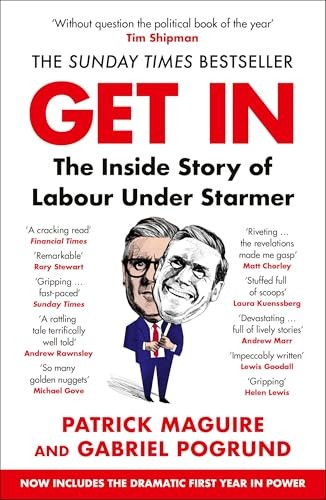
I’m writing this review while Keir Starmer is still the prime minister and will remain so for a little while longer. But everyone knows the game is up. Recently this blog covered The Science of Storytelling and predicted that Starmer’s story would turn out to be a tragedy. Get In shows all five acts. Patrick Maguire and Gabriel Pogrund give us a ringside seat to the thrills and spills of the Starmer circus. There’s a lot of frazzle but not much dazzle and we’re all a bit more weary by the time the lion comes out.
Under the five act structure the story might go like this: Keir and his friend Morgan (or is it the other way round) set out to win a general election. Their first foes are internal. They understand these foes and, although it isn’t easy, manage to sideline them. Act 2 sees Keir battle against unusual circumstances. Covid and lockdown give him less chance than he’d hoped to set out his stall and, besides, the country rallies round the incumbent prime minister. Act 3 is the Hartlepool by-election, the biggest challenge so far. There’s a lot of froth and a bust-up with Angela, who wins by going to sit in a pub. (Angela Rayner is one of the few people to come out of this book with their reputation enhanced.) Act 4 is the one in which the hero looks in the mirror and understands what the challenge really is, and what it will mean to them and either changes and takes on the battle or decides to go in a different way. And Act 5, of course, is the resolution and/or catastrophe. There is no reason why it can’t be both.
Act 4, for me, is where it all went wrong for Keir Starmer. And Get In shows that he knew it and everyone around him knew it. Generous commentators would say that at its best the Starmer government has been competent and, in some of its legislation, a little brave. But it has never had a narrative and Keir Starmer has never been at ease with the idea that there should be a ‘Starmerism’. He has brought in talented people to sharpen the comms but they have never been able to overcome his reluctance to give the nation a story to rally behind. Deliverism works when people can see the delivery. In an age of mis and disinformation that’s harder than ever.
Act 4 is where Starmer and McSweeney hollowed out their ideals. To gloriously mix political metaphors, they decided that the only way to get the Ming vase across the slippery floor was to get the barnacles off the boat – but they chose the wrong barnacles. For me, the saddest paragraph in Get In is where Starmer wants to enthusiastically adopt the ideas arising from the work of Michael Marmot and others on health inequalities but McSweeney ‘feared nothing more’ than Labour ‘talk[ing] even more loudly about inequality and unfairness’. Rather like in Borgen (itself a five act drama), the adviser chooses a short-term view that undermines the long-term values of their principal.
And so Act 5 sees Labour take office but without the plan for government that Keir hoped would be in place. And it turned out that despising the visionary elements of politics would not be a virtue. Long-term defeat would be inevitable.
Maguire and Pogrund enjoy being our confidants and their book is vivid and often entertaining. What’s missing is a sense of the why – not so much for Keir and Morgan but for those around them. What were the incentives, what were the objectives (other than to win)? We’re caught up so much in the details that it’s hard for the context to breathe. British politics could do with a little less breathlessness.
Update: it’s odd to add an update even before an article is even posted. But I wrote the above two months ago and wanted to know how it would settle before publishing it. I haven’t changed a word in the above but would add one admittedly obvious point. Our country has serious problems. But certainly since 2016 and probably before then, we haven’t been a serious country. Large parts of the political ecosystem are incentivised to keep it so. If we want a why, we are going to have to fight for it.


[…] both bewildering (he had himself met Starmer a few times and found him highly personable) and real. But as this blog has argued before, Starmer has starred in his own tragedy. Although the public seems to hanker for leaders who appear not to be politicians, we now have some […]